
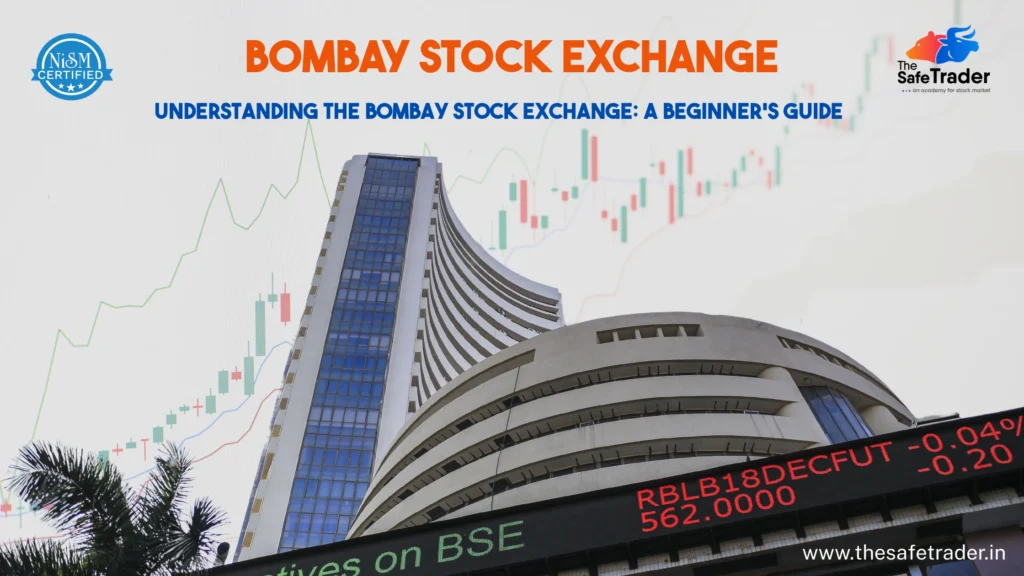
BSE, the first-ever stock exchange in Asia, was established in 1875. It is also the first in the country to be granted permanent recognition under the Securities Contract Regulation Act, 1956. It is the Fastest Stock Exchange in the world with a speed of 6 microseconds and is one of India’s leading exchange groups. In 1986, the Co-developed the S&P BSE SENSEX index, giving the Co. a means to measure the overall performance of the exchange. In 2017, it became the first listed stock exchange in India.
About BSE
Bombay Stock Exchange (BSE Ltd) is an Indian Stock Exchange located at Dalal Street in Mumbai. The Co. facilitates a market for trading in equity, currencies, debt instruments, derivatives, and mutual funds.
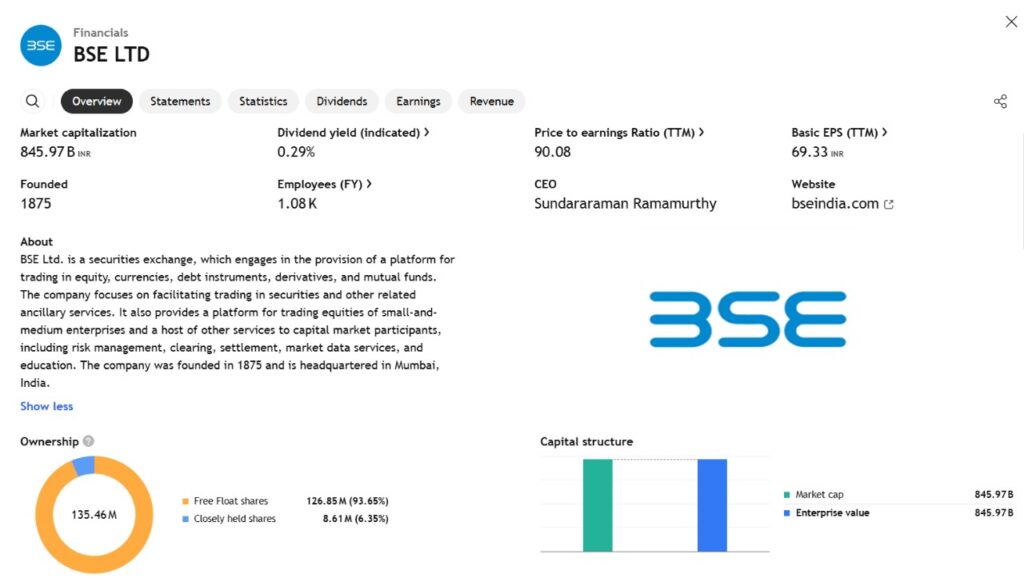
BSE Ltd. Stock Pros
Debt-Free company
- Being devoid of any debt, the BSE remains unaffected financially during crises, bolstering its sustainability from the long-term perspective.
Strong Quarterly Outlook
- Good quarterly-derived results and positive business momentum are expected in the coming quarters.
Solid Growth in Profits
- Strong growth in profits with a CAGR of 64.1% in the last 5 years-as an indication of distributive income growth.
Good Dividend Payout
- Maintains a dividend payout ratio of 41.1%, indicating that investors are consistently rewarded.
BSE Ltd. Stock Cons
High Valuation
- Currently, the stock trades at a price-to-book ratio of 20.4, possibly suggesting that the stock is overpriced compared to its net asset value.
Peer Comparison for BSE:
It compares BSE with other companies belonging to the same niche-i.e., financial services. BSE takes the lead in all the important key statistics:
- Highest Quarterly Net Profit: ₹493.67 crore, miles away from competition.
- Strong Sales Growth: With sales of ₹916.97 crore for the quarter, BSE is ahead of the others, having witnessed a 70.09% growth.
- High Return on Capital Employed (ROCE):43.54%, indicating optimal capital usage.
- Premium Valuation: BSE is trading at a P/E of 68.38, implying very strong investor confidence that glances over the 0.23% dividend yield.
- Market Cap Leader: ₹90,059 crore, underlining the biggest company in this group by size.
BSE Financial Highlights
1. Revenue Growth
- Sales have jumped from ₹228 crore in March 2022 to ₹917 crore in March 2025.
- This steady rise shows a strong expansion in day-to-day operations and a greater market share being absorbed on the exchange platform.
2. Operating Performance
- Operating Profit (PBIT) has risen steeply from ₹85 crore in March 2022 to ₹555 crore in March 2025.
- With such heavy dominance in revenue growth, there is further enhancement in the Operating Profit Margin (OPM%), gradually expanding from 37% to 60%, which means that operationally they are becoming even more cost-efficient and profitable.
3. Net Profit & EPS
- Net Profit has increased from ₹72 crore (Mar. 2022) to ₹494 crore (Mar. 2025).
- EPS rose from ₹5.51 to ₹36.52 in the same period, signaling high returns to shareholders.
4. Exceptional Quarter – June 2023
- Notably, in June 2023, BSE recorded an extremely high ‘Other Income’ of ₹430 crore, which severely swelled their PBT to ₹516 crore and Net profit to ₹440 crore.
- Such a spike might be because of a 1 time gain or some non-operating income usage like investments or asset sales.
5. The Leveraging in Action
- Costs have been kept under control while the revenues have surged, particularly from June 2023 onwards.
- This does show operating leverage, wherein fixed costs stayed consistent while surging revenue led to increased profitability.
Profit & Loss statement of a BSE from FY 2014 to FY 2025
- Sales and profits have increased significantly, with a huge increase in sales from ₹485 Cr to ₹3,212 Cr and net profits from ₹160 Cr to ₹1,322 Cr.
- Operating Profit Margins have been kept very strong, with 55% recorded in 2025.
- A pretty strong growth has been witnessed lately by the company, with 102% sales growth in TTM and 189% profit growth in TTM.
- Return on equity has improved; it was 34% in the last year, which is an indicator that the capital has been properly utilized.
- Earnings PerShare increased from ₹4.34 to ₹97.94 during the period.
- Dividend payout has been a bit erratic, lower in recent years (23% in 2025).
The stock has done really well, giving 137% returns in the past one year alone and 120% CAGR over 5 years.
BSE Balance Sheet Analysis (Mar 2014 – Mar 2025)
Strong Asset Build-up:
- Assets witnessed a healthy growth, from ₹4,066 crore (2014) to ₹10,342 crore (2025).
Steady Increase in Reserves:
- From ₹2,366 crore to ₹4,397 crore, reserves stand to show an increasing trend in retained earnings.
Debt-Free:
- In keeping with BSE’s style of discipline, serially little or almost nil borrowings have been maintained and are considered a safe avenue.
Being Operation-Linked, Other Liabilities Rise:
- A good rise in other liabilities has been witnessed in 2024-25, most probably due to market volumes and operations.
Good Investment Portfolio:
- Investments keep on rising and stand at ₹2,845 crore, indicating efficient usage of funds.
Growth in Infrastructure:
- An increase in CWIP (₹41 crore in 2025) means progressing infrastructure or technology upgrades.
Financially Sound and Low-Risk:
- The Balance Sheet gives a picture of a conservative, stable, and well-managed organization.
Cash Flows and Ratios of BSE Ltd.
Cash Flows (₹ in Crores)
- Cash from Operating Activity:
- Volatile over the years. Highest in Mar 2024: ₹2,842 Cr, showing strong core operations.
- Negative in multiple years (e.g., 2015, 2016, 2018), indicating operational stress at times.
- Volatile over the years. Highest in Mar 2024: ₹2,842 Cr, showing strong core operations.
- Cash from Investing Activity:
- Mostly negative, especially in 2022–2025, indicating heavy investments in assets or acquisitions.
- Mostly negative, especially in 2022–2025, indicating heavy investments in assets or acquisitions.
- Cash from Financing Activity:
- Frequently negative, suggesting debt repayment or dividend payouts.
- Positive only in a few years (e.g., 2018, 2022).
- Frequently negative, suggesting debt repayment or dividend payouts.
- Net Cash Flow:
- Large fluctuations; strong positive in Mar 2017: ₹827 Cr, Mar 2024: ₹1,622 Cr, but negative in Mar 2025: ₹-563 Cr.
Cash Flows (₹ in Crores)
Cash From Operating Activities:
- It shows volatility throughout the years, having hit the major peak in March 2024 of ₹2,842 Cr because of strong core operations.
- Negative in the years 2015, 2016, and 2018, signifying that the operations sometimes faced stress within the time.
Cash From Investing Activities:
- Majorly negative especially during 2022–2025, indicating heavy outflow for investments in fixed assets/acquisition.
Cash From Financing Activities:
- Mostly negative, indicating repayment of debt or dividend payments.
- Positive, however, in a few years, such as 2018 and 2022.
Net Cash Flow:
- Fluctuated greatly; strongly positive in Mar 2017: ₹827 Cr, Mar 2024: ₹1,622 Cr, but negative in Mar 2025: ₹-563 Cr.
Key Financial Ratios
- Cash Conversion Cycle (CCC):
- Generally low and efficient, especially in Mar 2022: 28 days, and improving again in Mar 2025: 35 days.
- Reflects efficient working capital management.
- Generally low and efficient, especially in Mar 2022: 28 days, and improving again in Mar 2025: 35 days.
- Working Capital Days:
- Negative throughout, indicating high current liabilities or strong supplier credit terms.
- Deepest in Mar 2022: -1,148 days, improving to -279 days in Mar 2025.
- Negative throughout, indicating high current liabilities or strong supplier credit terms.
- ROCE (Return on Capital Employed):
- Consistent growth, peaking at 44% in Mar 2025, showing highly efficient capital usage.
- Just 5–10% in early years, with a major rise after 2017.
- Consistent growth, peaking at 44% in Mar 2025, showing highly efficient capital usage.
Shareholding Pattern for a BSE Ltd:
- Foreign Institutional Investors (FIIs):
- FIIs’ stake grew significantly from 0% in Jun 2022 to 16.78% in Mar 2025.
- Indicates increasing global investor interest in the stock.
- FIIs’ stake grew significantly from 0% in Jun 2022 to 16.78% in Mar 2025.
- Domestic Institutional Investors (DIIs):
- DIIs had fluctuating but growing interest, increasing from 12.04% (Jun 2022) to 12.33% (Mar 2025).
- DIIs had fluctuating but growing interest, increasing from 12.04% (Jun 2022) to 12.33% (Mar 2025).
- Public Shareholding:
- Declined from 61.81% in June 2022 to 48.78% in Mar 2025.
- Reflects possible movement of shares from retail/public to institutional investors.
- Declined from 61.81% in June 2022 to 48.78% in Mar 2025.
- Others Category:
- Gradually decreased from 26.14% in June 2022 to 22.11% in Mar 2025.
- Gradually decreased from 26.14% in June 2022 to 22.11% in Mar 2025.
- Number of Shareholders:
- Increased steadily from 4.46 lakh in June 2022 to 6.68 lakh in Mar 2025.
- Suggests growing retail participation or interest in the stock.
- Increased steadily from 4.46 lakh in June 2022 to 6.68 lakh in Mar 2025.
Conclusion
The Bombay Stock Exchange did stretch its arms far from its humble 19th-century beginnings. Today it plays the important role of raising capital, offering investment opportunities, and serving as the economic barometer. The trick of the trade here is that whether you are an inexperienced investor or an experienced trader, knowing how BSE operates will empower you with tools and know-how to pursue the opportunities in India’s dynamic financial landscape.
As India proceeds forward to become one of the largest economies in the world the future of BSE will remain full of opportunities for innovation, investment, and economic development.
Want to Know More Details, Please Click Here
