
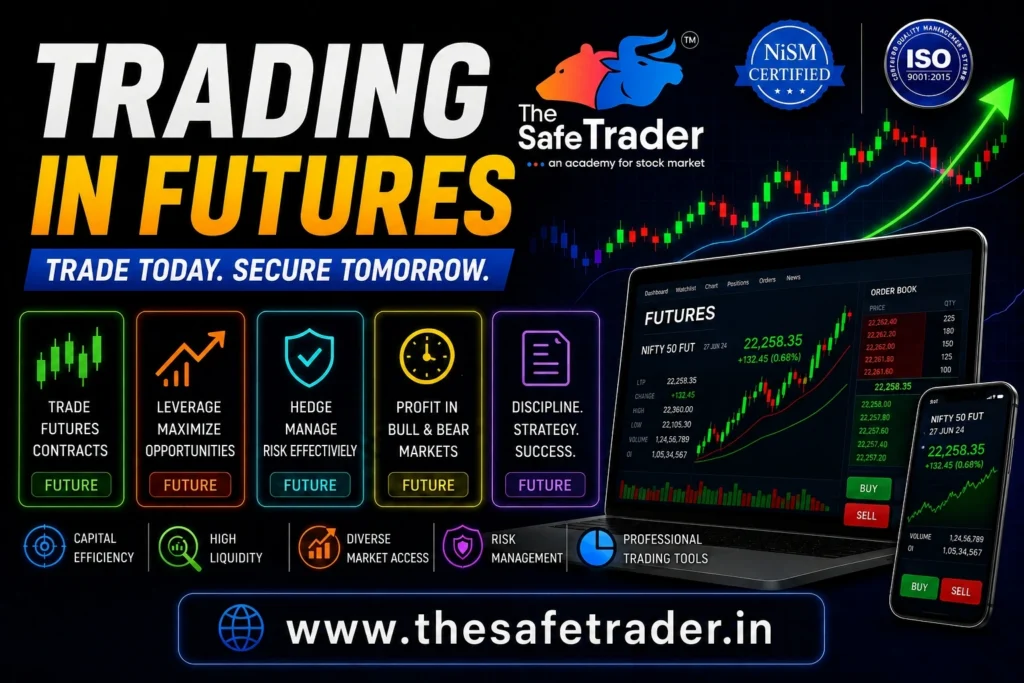
Trading in Futures
Futures trading can sound intimidating, especially with terms and concepts like margin and leverage, expiry, contracts, and mark to market. But it all boils down to a simple concept. A contract to buy or sell an underlying asset at a predetermined future price. In India, futures are available on indices like Nifty and Bank Nifty, stocks, and commodities.
A futures contract can help you profit from both rising and falling markets. But due to leverage, futures trading can be much riskier if you don’t know what you’re doing.
In this complete beginner’s guide to future trading, let’s discuss what is futures trading, its benefits and risks, plus some basics you must know before you start trading futures.
What Is Futures Trading?
Trading in future contracts usually involves buying or selling a contract, the value of which is derived from an underlying asset.
For example, you can trade a future contract based on a stock or a stock index.
A future contract contains the following details:
● The underlying asset
● Contract size or lot size
● Expiry date of the contract
● Future price
● Required margin
Unlike traditional stock market investing, future contracts only require a fraction of the value of the contract as margin. So, you can see how future trading can allow you to benefit from leverage.
How Do Futures Work?
Let’s say, for example, the Nifty future is quoting at 22,000. You have a view that the Nifty is going to rise, so you take a long future position.
Now, if the Nifty rises, the value of your long position will increase, and you profit from the move. If the market goes down, you book a loss.
Similarly, if you have a view that the market is going to go down, you can take a short position and profit from the decline.
The important thing to note is that the profits and losses depend on the lot size of the future and the movement in the price of the underlying.
Why Do Traders Buy Future Contracts?
1. Leverage
As mentioned above, futures require only a small percentage of the notional value of the contract as margin. So, while leverage can amplify profits, it can also increase losses
2. Trade in Bull and Bear Markets
Futures contracts allow you to go long and short in the market. That means you can profit from bullish markets by opening long positions and bearish markets by opening short positions.
3. Hedging
A future position can help hedge an existing position. For example, you can hedge a large equity position by taking a short position in index future contracts to offset possible losses due to a market crash.
4. Liquidity
Future contracts on popular indices and equities tend to have high liquidity. This means it is easy to enter and exit trades with such contracts.
Basics Of Future Trading Every Beginner Must Know
Before we proceed, let’s first discuss some commonly used futures trading terms to help you understand future contracts better.
Margin – The amount of money you need to deposit to open a future position
Lot Size – The number of shares or units of an underlying represented in one future contract
Expiry – The date on which a future contract expires
Long Position – A buy position in future, taken with the view that the price of the underlying will rise
Short Position – A sell position in future, taken with the view that the price of the underlying will fall
Mark to Market – The daily settlement of profits and losses on a future position
This completes our beginner’s guide to future trading basics.
Risks Of Future Trading
Future trading is not a magic wand. In fact, future trading can end up being much riskier than you anticipated due to leverage and other factors. Some of the most common risks are:
1. Leverage Risks
The leverage on future positions can cause massive gains or losses if the market moves rapidly against your position or in your favor. In fact, even small price changes can have outsized impacts on future positions due to the leverage.
2. Stop Loss Discipline
Most traders who lose money in future trading do so because they fail to cut losses. You can give yourself a break from trading if you are in a losing position for too long.
3. Expiry Risks
Your future positions can go bankrupt if you hold a long position during a market downturn or hold a short position during a market uptick. Always remember that you need to exit your positions before expiry.
Other risks include
● Losing money due to overtrading
● Taking big positions unnecessarily
● Failing to understand margin requirements
● Trading on tips without any market knowledge
As you can see, risk management and discipline are of utmost importance in future trading.
That brings us to the next topic.
Future Trading Vs Equity Trading
The most significant difference between future trading and conventional equity trading is exposure. While an equity trader buys and sells stocks, a future trader buys and sells future contracts on stocks, indices, commodities, and more.
Futures offer much more leveraging, allowing a trader to take bigger positions with less capital. On the flip side, leverage can also cause bigger losses. Traders can also go short in future trading, unlike regular equity traders. But at the same time, you also have to understand position sizing and margin requirements better in future trading.
How Can Beginners Start Trading In Futures?
Here are some tips that can help you start future trading:
● Understand how future contracts work
● Know the ins and outs of margin, lot size, and price action
● Learn price action and chart patterns
● Set up an entry and exit strategy
● Always set a stop loss and limit order for each trade
● Take small positions
● Keep a trading journal and keep track of your performance
If you are a complete newbie in the world of derivatives, you must start by learning Futures & Options trading thoroughly. That way, you will be able to understand market fundamentals, concepts, and risk management practices before risking your money.
Conclusion
As we have seen, future trading can open up a world of opportunities for you. But, at the same time, it also requires much more discipline and risk management. Leverage is the double-edged sword in the world of future trading. It helps you make more significant profits, but at the same time, it can also cause massive losses if you hold a large position.
At The Safe Trader Academy, our goal is to educate future traders about market fundamentals and risk management practices to help them succeed.
As a beginner, you must take care to avoid taking unnecessary risks to make a quick buck. Learn, practice, and manage your risks, and you will soon be a profitable future trader.
📞 WhatsApp / Call: +91 92975 06666
🌐 Website: www.thesafetrader.in