
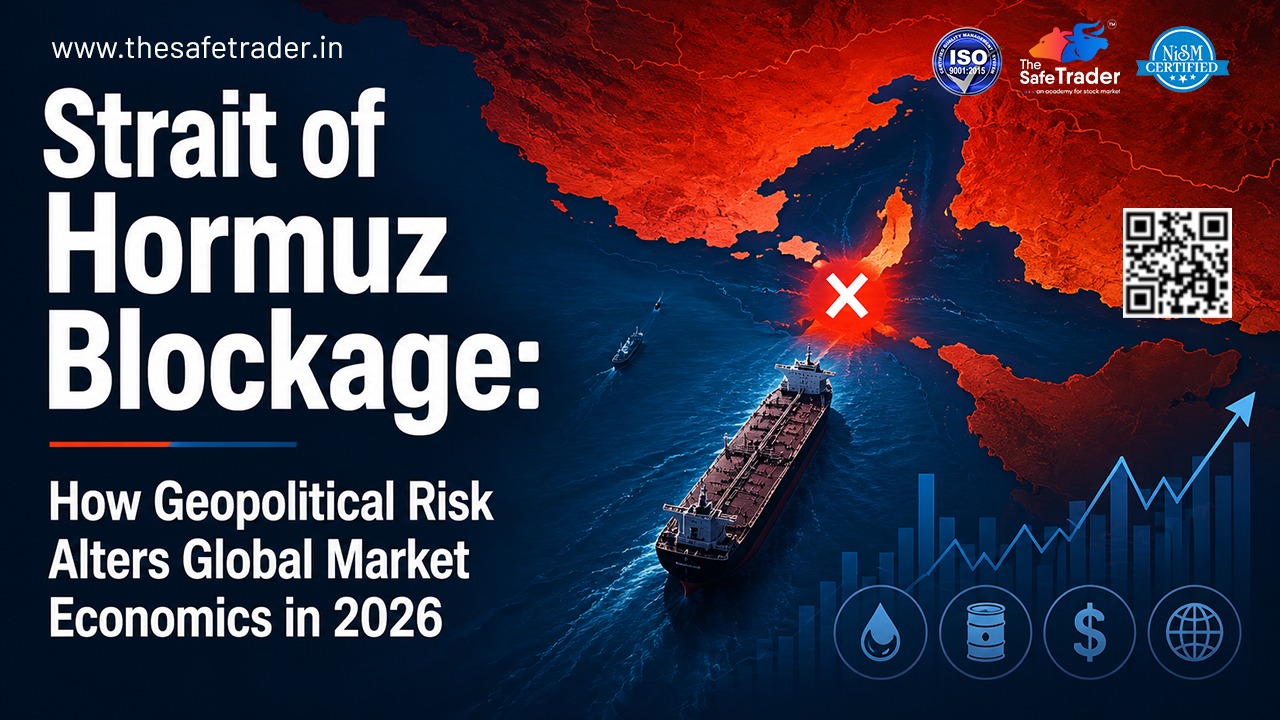
The tensions in the Middle East, specifically, the military action that involves the United States and Israel against Iran, have created ripple effects extending beyond geopolitics and into global economics. This impact affects the global energy markets, inflation, supply chains, and financial markets.
Key Takeaways:
- The 2026 crisis marks the first full blockade of the Strait of Hormuz in modern history.
- Major maritime carriers have had to use the Cape of Good Hope, leading to compounding container shipping times and air-cargo freight.
- Escalating global energy and supply chain overhead locked the central banks in a stagflation trap.
- The shipping blockade hits the domestic corporate margins, which have pushed the Rupee to historic lows.
Tensions have escalated significantly in the Middle East following joint military strikes by the U.S. and Israel against strategic targets in Iran. In retaliation, Iran has engaged in missile and drone attacks in the region. This has led to authorities threatening to restrict maritime traffic through the Strait of Hormuz, a key transit point.
As this ongoing situation has had a significant impact on global economics, it has led to a global and asymmetric shock. It is not only upending the livelihoods within the region, but it has also dimmed the outlook of many economies, which have only started showing signs of a sustained recovery from the previous crises.
With this blog, let’s look into the exact impact of this war on trade economics and global economic conditions.
Supply Chain Fractures and Chokepoints of Maritime Trade
The conflict of the US and Israel against Iran has triggered a severe dual-chokepoint shipping crisis. This has led to crippling the major commercial transits in the Strait of Hormuz and has worsened the ongoing disruptions at the Bab-el-Mandab Strait. These two passages that connect Asia to Europe handle roughly one-third of the global seaborne crude oil trade and a significant share of cargo.
Due to the conflict, all of the five major container lines, Maersk, MSC, CMA CGM, Hapag-Lloyd, and COSCO, have suspended or halted transits through Hormuz. This has led to them rerouting through the Cape of Good Hope, which has added weeks to the voyage times.
The practical consequences of this for businesses have extended well beyond the increased shipping costs. The rerouting has absorbed vessel capacity, leading to delays cascading around trade lanes without any direct connection to the Middle East. Companies sourcing components from Asia, or ones that ship finished goods to Europe, or even depend on Just-in-Time inventory models, expect weeks of extensive delays.
The war’s impact on the global economy has also led to major disruptions in three of the world’s busiest air cargo hubs (Doha, Dubai, and Abu Dhabi). This has left the affected businesses to compete for scarce logistics options in a market where scarcity has already become the defining feature.
The Hormuz Disruption and Impact on Global Trade Economics
The Strait of Hormuz, a central artery for the global energy trade, has observed the fall of activity into a near halt. As per a UNCTAD study, this has led to ship transits dropping from 130 a day in February to only 6 in March. In percentages, this can be described as a 95% collapse.
The Four Waves of the 2026 Middle East Energy Shock
Before diving deep into how the war and the virtual closing of the Strait of Hormuz have led to rising costs disrupting the global economy, let’s look into the four phases of the shock:
| Wave Phase | Manifestation & Economic Consequences |
| First Wave (Immediate) | Spikes in Brent crude and LNG benchmarks, leading to immediate surges in global maritime freight. |
| Second Wave (Downstream) | Surging input costs force surcharges of 30%+ in heavy industrial sectors like steel or chemicals. |
| Third Wave (Agricultural) | Surging fertilizer prices and transport overhead spark global food supply chain emergencies. |
| Fourth Wave (Macroeconomic) | Central banks delay interest rate cuts, and prolonged stagflationary pressures slow global GDP growth. |
Table: The Four Waves of the Energy Shock
A Critical Supply Route at a Standstill
As the Strait of Hormuz remains virtually closed, energy flows are getting disrupted, causing the effects to spread through the global economy within weeks of the disruption. This has further led to prices being raised and financial pressure on developing countries increasing.
Moreover, the Hormuz disruption has had immediate consequences on production, trade, and consumption worldwide. It has also spilled over into the transport systems, affecting air cargo and port logistics.
Energy Shock and the Global Economy
The main route by which the conflict has affected global trade economics has been sharp escalations in fuel prices as of February 28th. The primary cause of this has been an increase in oil transport costs.
Liquefied natural gas (LNG) carriers have been hit the hardest because of this, facing reduced volumes and increased risk costs. Container and dry bulk shipping, meanwhile, has not been hit as hard but has still faced rising costs and disruptions.
Loss of Trade and Growth Momentum
2026 saw trade starting on a strong footing, but is expected to lose momentum as the year progresses. On that note, growth in global merchandise trade is projected to decelerate from about 4.7% in 2025 to ranging between 1.5% and 2.5% in 2026 due to rising uncertainties and weakened global demand.
Developing Countries are the Most Exposed
The effects of this disruption have been seen most in developing economies. Higher energy prices have increased import costs. Alternatively, weaker currencies have amplified the pressure. Meanwhile, tighter financial conditions have reduced governments’ ability to respond.
The impact has been further compounded by rising import costs for energy, food, and fertilizers, alongside weaker external demand. This is a critical example of war and inflation being interconnected.
Supply-Driven Inflation: The Stagflation Trap
The effective management of a portfolio during geopolitical crises depends on the ability of traders to differentiate between demand-pull inflation and cost-push supply shocks. This current inflationary spike is completely structural. A maritime blockage and the global economic impact of this cannot be solved by central banks through monetary policy measures.
This is where a stagflation trap triggers. When the production or accrual costs for essential inputs like oil, gas, and transport logistics skyrocket due to conflict, the burden of these costs is directly transferred to the consumers.
Moreover, if central banks aggressively lower interest rates to shield against the slowdown of domestic economies, they risk unanchoring inflation expectations completely. Alternatively, sustaining elevated benchmark interest rates to combat supply-side price hikes can add intense downside pressure on corporate margins and consumer credit. This increases the risk of a technical recession.
Consequently, significant financial institutions, such as the European Central Bank and the US Federal Reserve, have been forced to put highly anticipated rate cuts on hold. Therefore, souring the sentiment in the global markets.
The Impact of Global Trade Economics Disruptions on the Indian Market
The Indian stock market has been impacted significantly due to the USA-Iran conflict. The volatility along the Strait of Hormuz has translated directly into significant macroeconomic strain on India.
India imports almost 88% of its annual crude oil requirements, amounting to 1.8 billion barrels. Consequently, any sustained price elevation acts as a direct tax on the domestic economy.
Hence, with the U.S.-Iran conflict, there has been a swift reaction on the Indian Stock Market. This reaction can be noted as:
- Foreign Capital Flight: Foreign investors would quickly pull massive amounts of capital out of the emerging markets, such as India. This step is considered a system of mitigating global risk. A common sight in this situation would be thousands of crores in net foreign investment outflows only days after the escalation of the conflict.
- Pressure on the Rupee: The dual damage due to rising import costs and capital flight has caused the Indian rupee (INR) to weaken significantly when compared to the U.S. Dollar. INR has hovered near 95.7 per dollar as a direct impact of the conflict.
Final Verdict
The economics of modern warfare have proven that markets do not operate in isolation. A geopolitical conflict in one hemisphere can completely rewrite the global economic forecasts. Thus, leading to significant changes in inflationary tendencies, supply chain strategies, and interest rate paths for nations.
As the Strait of Hormuz becomes a significant maritime chokepoint, the global trade economy, including the Indian trade market, needs to prepare for a lower-growth and higher-cost reality.
Secure Your Trading Strategy Against Global Vulnerability
To navigate an economy defined by geopolitical uncertainty and sticky inflation demands, you need institutional-grade market intelligence. So, do not leave your portfolio exposed to sudden macroeconomic shifts and supply chain shocks. Join The Safe Trader, and with the help of our premium risk management frameworks, safeguard your wealth irrespective of market conditions.
Frequently Asked Questions (FAQs)
1. Why is the Strait of Hormuz Called a Critical Maritime Chokepoint for Traders in 2026?
The only alternative to the Strait is the Cape of Good Hope, which increases the travel distance for freight significantly. Thus, any disruption to Hormuz directly dictates the global economy’s spot pricing.
2. Why are Major Central Banks Delaying Interest Rates Despite Global Economic Growth?
The Fed and the ECB face a severe stagflation trap. Driven by unanchored inflation expectations, central banks must keep benchmark rates higher for longer, delaying highly anticipated rate cuts despite slowing global growth metrics.
3. Why is the Global Food Security Market Directly Tied to the Hormuz Crisis?
The Persian Gulf region accounts for nearly one-third of the world’s seaborne fertilizer trade. As the production of nitrogen-based fertilizer directly depends on natural gas, the combination of stranded regional LNG exports and restricted shipping routes has sparked an immediate shortage in global food supply.
4. How is Cost-Push Supply Shock Different from Demand-Pull Inflation in the Trade Market?
Demand-pull inflation takes place when strong consumer spending outpaces economic production, which is cooled down by hiking interest rates. A cost-push supply shock, on the other hand, is triggered by a shortage of essential raw materials. In this environment, traditional monetary policy can offer limited relief.
5. How can Investors Protect their Portfolios from this Stagflation Crisis?
Traders need to move away from high-beta, import-dependent market assets and shift towards robust safe-haven assets in the case of financial disruptions. In these scenarios, using long-volatility options strategies can allow traders to capture the profit from major price swings.