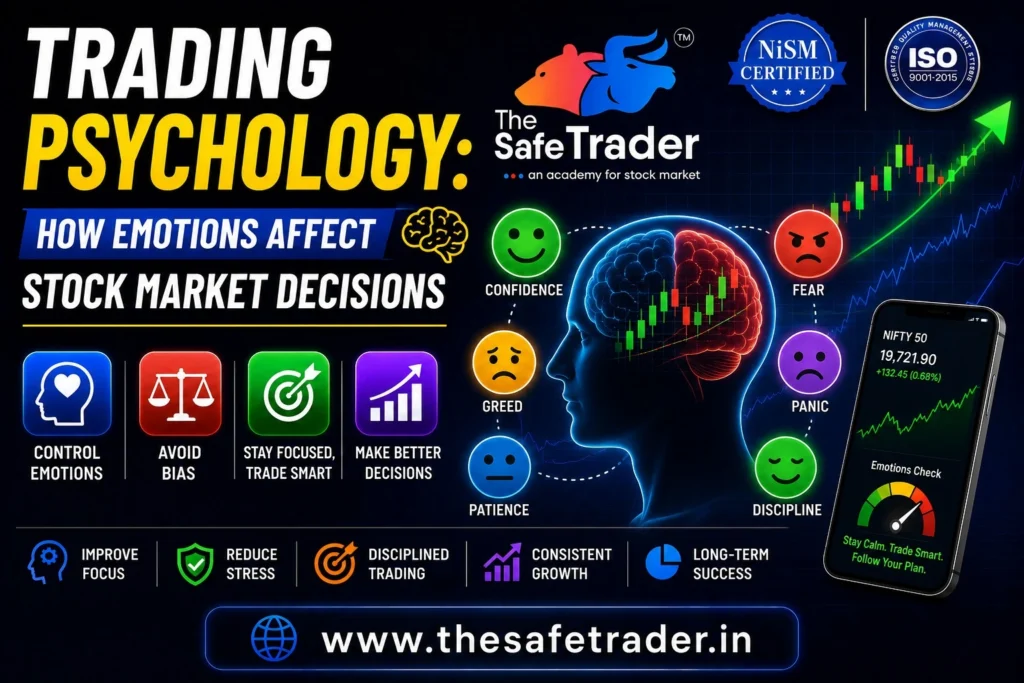
Trading involves charts, indicators, strategies, and numbers. However, your mind can influence your results even more.
A trader may have a profitable strategy but still lose money due to fear, greed, overconfidence, FOMO, impatience, and revenge trading. That’s why trading psychology is an essential part of successful stock market trading.
In this guide, we will explore how emotions shape trading decisions and how you can develop the discipline needed for consistent trading.
What Is Trading Psychology?
Trading psychology refers to the emotional and mental factors that affect a trader’s decisions in the stock market.
Two traders can look at the same chart and use the same strategy, yet still make completely different choices based on their mindset.
A disciplined trader sticks to a trading plan, even when a trade goes against them. An emotional trader might remove a stop loss, jump into another trade right after a loss, or exit a winning position too early.
So, becoming a better trader isn’t just about learning technical analysis; it’s also about managing your emotions.
The Biggest Emotions That Affect Traders
1. Fear
Fear often arises after a trader experiences losses.
A fearful trader may:
- Exit a good trade too early
- Avoid taking a valid setup
- Move the stop loss closer
- Hesitate after a previous losing trade
Fear can prevent traders from effectively following their strategy.
2. Greed
Greed often appears when a trade is already profitable.
A trader may hesitate to take profits because they expect the stock to rise even more. They may also increase their position size unnecessarily.
This can result in giving back profits or turning a winning trade into a losing one.
3. FOMO
Fear of Missing Out (FOMO) happens when traders jump into a trade because they believe everyone else is making money.
For example, if a stock suddenly rises 8 to 10%, a trader might buy it without waiting for a proper setup.
FOMO trading often leads to buying near the peak.
4. Revenge Trading
After a loss, some traders quickly enter another trade to recover their funds.
This is known as revenge trading.
Instead of sticking to a strategy, the trader tries to “win back” the previous loss. This can create a cycle of emotional decisions and lead to even bigger losses.
5. Overconfidence
A few successful trades can make a trader feel invincible.
This might result in:
- Increasing position sizes
- Ignoring stop losses
- Taking low-quality trades
- Overtrading
While confidence is important, overconfidence can be dangerous.
How to Develop Better Trading Psychology
Follow a Trading Plan
Before entering a trade, decide on:
- Entry price
- Stop loss
- Target
- Position size
- Risk-to-reward ratio
Once the trade is active, avoid changing your plan based solely on emotions.
Use Proper Risk Management
Never risk an amount that could significantly impact your financial situation.
Proper position sizing and sticking to stop losses can help reduce the emotional pressure tied to individual trades.
Maintain a Trading Journal
Record every trade and include:
- Why you entered
- Entry and exit
- Stop loss
- Target
- Profit/loss
- Emotional state
- Mistakes made
Reviewing your trading journal can help identify recurring behavioral mistakes.
Accept Losses
Losses are a normal part of trading. Even a solid strategy can result in losing trades.The goal isn’t to avoid every loss but to keep individual losses manageable and to follow your strategy consistently.Psychology Matters More Than You Think
Successful trading requires more than just finding the right indicator or strategy. You need to stay calm during market ups and downs and stick to your rules when emotions run high.
A strong trading mindset involves:
Plan → Execute → Manage Risk → Review → Improve
Instead of asking, “How much can I make from this trade?” focus on, “How well am I following my trading plan?”
This shift in mindset can make a significant difference over time.
Conclusion
Trading psychology is one of the most important skills every stock market trader should develop. Fear, greed, FOMO, revenge trading, and overconfidence can affect decisions and lead traders to ignore their strategies.
By creating a trading plan, managing risk, keeping a trading journal, and accepting losses as part of the process, you can achieve better emotional control and trading discipline.
At The Safe Trader Academy, trading education goes beyond just charts and strategies. The academy’s programs include technical analysis, risk management, and trading psychology as part of a practical education in the market.
The goal isn’t to eliminate emotions entirely. It’s about learning to make trading decisions without letting emotions take charge.
📞 WhatsApp / Call: +91 92975 06666
🌐 Website: www.thesafetrader.in
Frequently Asked Questions
1. What is trading psychology?
Trading psychology is the study of how emotions and mental states influence a trader’s decisions and behavior in financial markets.
2. What is the most dangerous emotion in trading?
There isn’t one universal answer. Fear, greed, FOMO, revenge trading, and overconfidence can all cause significant mistakes depending on the situation.
3. How can I control emotions while trading?
Use a written trading plan, predefined stop losses, proper position sizing, and a trading journal. These tools can reduce impulsive decision-making.
4. Why do traders revenge trade?
Revenge trading usually happens when a trader tries to recover a recent loss quickly. This often leads to taking trades outside their normal strategy.