
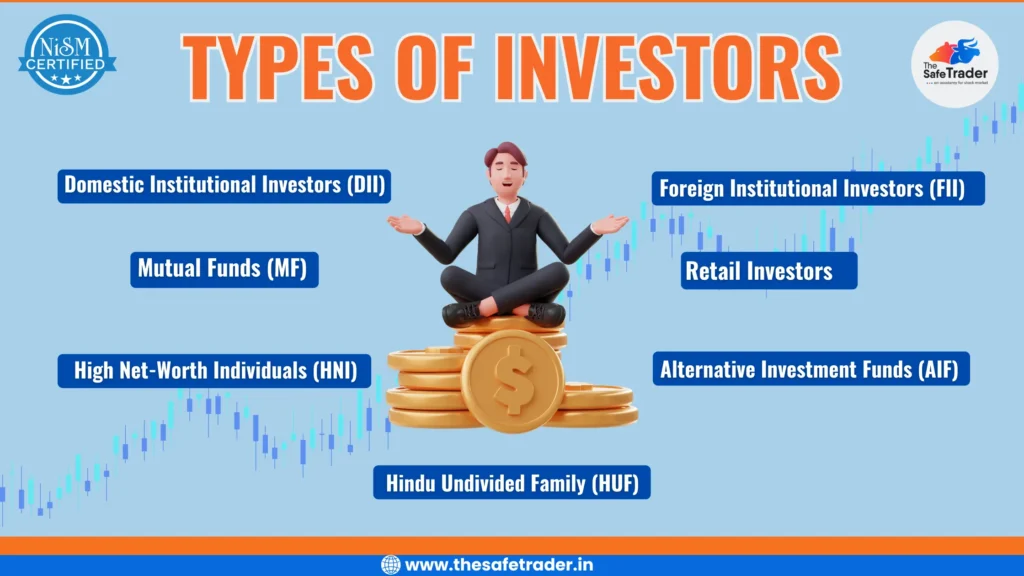
The Indian Stock Market is one of the largest and fastest-growing equity markets globally, driven by a mix of domestic and foreign investors. Each type of investor plays a distinct role in shaping market movements, liquidity, and sentiment. Let’s explore these types, their roles, and their impact — with real numbers and trends.
Domestic Institutional Investors (DII)
DIIs include mutual funds of India, insurance companies, pension funds, banks, and other big entities investing in domestic securities.
- DIIs collectively owned about 16 to 18% of NSE-listed companies (as of 2024).
- Mutual funds alone have AUM (Assets Under Management) of over ₹52 lakh crore
Impact:
In many cases, DIIs are the counterforce to FIIs. For example, when FIIs withdraw more than a lakh crore between 2022 and 2023 because of global uncertainty, DIIs gave support to the market with net inflows of nearly the same magnitude.
Foreign Institutional Investors (FII)
FIIs/FPIs are overseas funds investing in Indian equities, debt, and other securities.
- FIIs own about 18–20% of the Indian equity market capitalization.
- The year 2024 saw FIIs yield lucrative net inflows of above ₹1.4 lakh crore in the equity market-the result of renewed interest in India as a growth market.
Impact:
Generally, FIIs hold the status of suggestive influences of the market. Heavy inflows by them generate upward trends (take post-COVID), while their withdrawal creates volatility.
High Net-Worth Individuals (HNI)
HNIs are individuals with significant investable surplus, often above ₹2 crore, investing in stocks, bonds, PMS schemes, or AIFs.
- The number of HNIs in India crossed 4.5 lakh individuals in 2023.
- HNIs account for a significant chunk of direct stock market investment volumes, especially in mid-cap and small-cap spaces.
Impact:
HNIs often take concentrated bets or participate in block deals. Their moves are closely watched by brokers and analysts.
Retail Investors
These are individual investors who invest small amounts compared to institutions and HNIs. They participate through direct stocks, mutual funds, or ETFs.
- For the record, more than 140 million demat accounts were active as of early 2024 — a sharp rise from about 40 million in 2019.
- Direct holdings by these retail investors are around 7–8% of the total market capitalization.
Impact:
Retail investors dominate trading volume in small-cap and mid-cap stocks and are quickly becoming a force within IPO subscription.
Hindu Undivided Family (HUF)
The Indian legal system allows the traditional family investment structure, treated as a separate entity for tax and investment purposes.
HUFs have no separate public record for their holdings but form part of the retail/HNI investor set. They subconsciously get associated with long-term wealth-building opportunities like holding blue-chip stocks or mutual funds.
Alternative Investment Funds (AIF)
As the name indicates, they pool money from HNIs and institutional investors to invest in non-traditional assets such as private equity, venture capital, real estate, distressed debt, and hedge funds.
- AIFs have grown rapidly, with total AUM crossing ₹10 lakh crore in 2024.
- Category II AIFs (private equity, real estate funds) constitute the largest share.
Impact:
AIFs take the Indian startup ecosystem, infrastructure, and other alternative sectors to more depth than what public markets offer.
Mutual Funds (MF)
Mutual funds pool savings from retail and HNI investors and invest in diversified portfolios of stocks, bonds, or hybrid assets.
- MF industry AUM: ₹52–55 lakh crore as of mid-2024.
- SIP contributions: Over ₹19,000 crore per month, showing rising retail participation.
Impact:
Mutual funds help channel domestic savings into the stock market and are key drivers of long-term stability and disciplined investing.
Snapshot of Ownership (2024)
| Investor Type | Market Share in NSE-Listed Cos (Approx.) |
| FIIs / FPIs | 18% – 20% |
| DIIs | 16% – 18% |
| Mutual Funds | Part of DIIs (AUM ₹52 lakh crore) |
| Retail + HNI | 7% – 8% |
| Government | ~6% (through direct holdings in PSUs) |
Conclusion
The Indian stock market is a blend of domestic and global forces:
- FIIs bring foreign capital but also volatility.
- DIIs and MFs provide stability through steady investments.
- Retail and HNIs represent growing confidence in equity as a wealth creator.
- AIFs and HUFs add diversity and long-term depth.
As an investor, understanding these players helps you interpret market moves better and design smarter strategies!
