Thesafetrader

Author: thesafetrader.in

  • Trump’s 50% Tariff Shock: How Will It Impact the Indian Stock Market?

    Trump’s 50% Tariff Shock: How Will It Impact the Indian Stock Market?


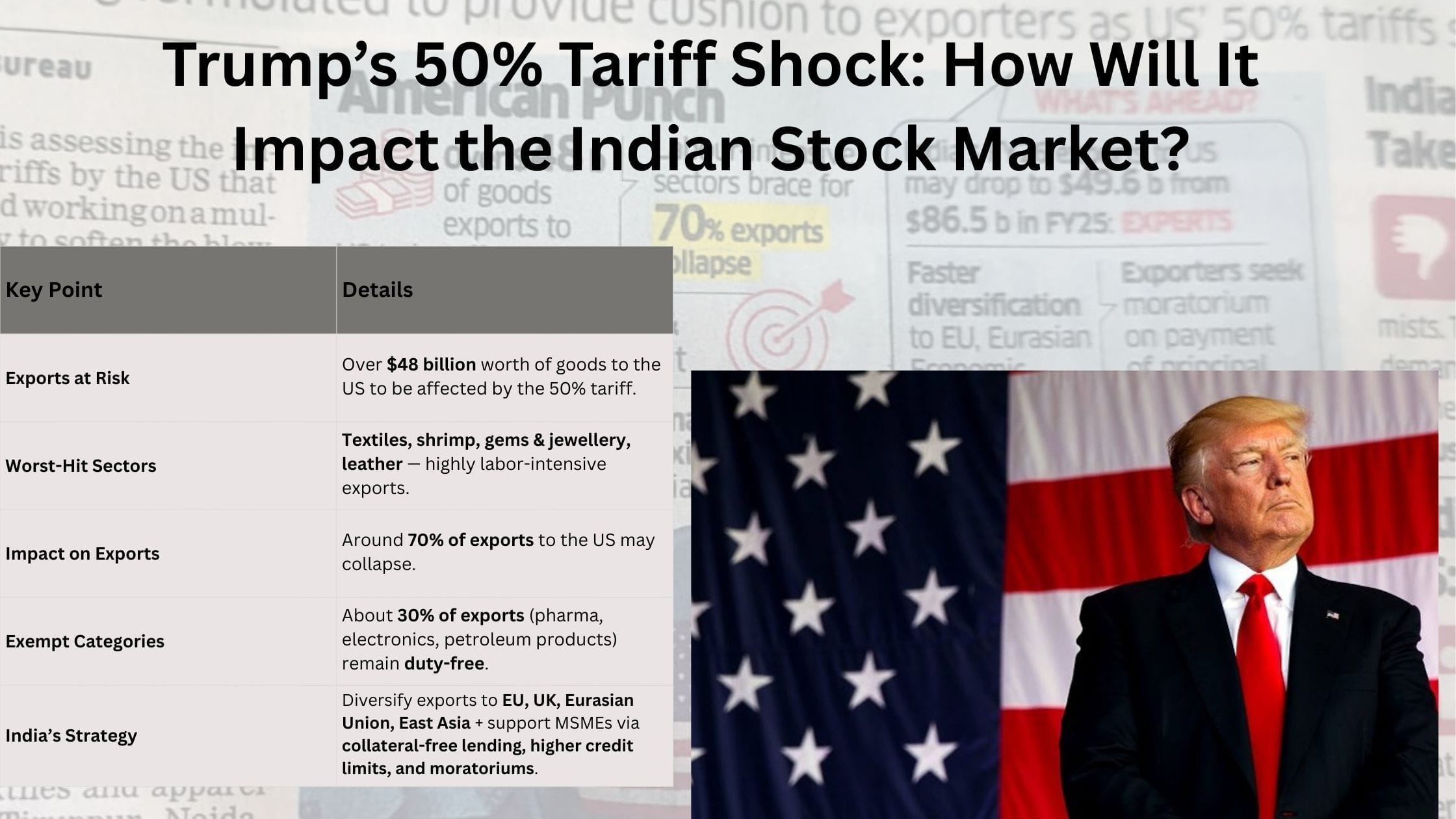
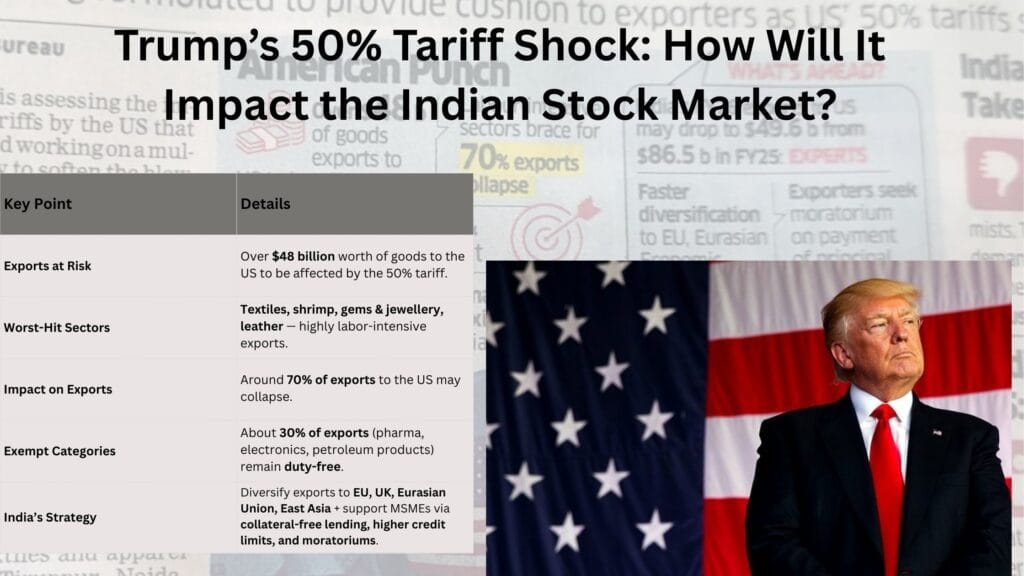
    Indian exports face US 50% tariff impact – infographic showing textiles, shrimp, gems and jewellery worst hit, with $48B trade at risk.


    President Trump’s 50% tariff on Indian exports has sent shockwaves across global trade. With over $48B at risk, India’s textiles, gems, and shrimp industries face the hardest blow. Here’s a deep dive into the impact on exports, stock markets, and India’s strategy to counter this challenge.

    When American President Donald Trump declared a 50% tariff on Indian products, it created ripples across the world markets and policy circles. For India, whose exports to America amount to approximately $86.5 billion every year, this is not only an economic shock but also a strategic setback. With labor-intensive industries such as textiles, gems, jewelry, shrimp, and leather in the firing line, the impact is anticipated to cascade into India’s economy, equity markets, and jobs. However, amidst the crisis is a chance for India to reform, diversify, and come out on top.

    Why This 50% Tariff Matters

    The U.S. continues to be India’s biggest export market, taking nearly 17% of India’s total exports. By using a punitive tariff of 50%—double the previous 25%—the U.S. has essentially doubled the price of Indian goods for American consumers. This makes Indian exports considerably less competitive compared with those from China, Vietnam, Bangladesh, and other Asian rivals.

    More than $48 billion of Indian exports will be adversely affected, as per government estimates. Experts caution that in certain industries, shipments could be up to 70% wiped out, resulting in devastating revenue and employment losses.

    Industries in the Line of Fire

    Key PointDetails
    Exports at RiskOver $48 billion worth of goods to the US to be affected by the 50% tariff.
    Worst-Hit SectorsTextiles, shrimp, gems & jewellery, leather — highly labor-intensive exports.
    Impact on ExportsAround 70% of exports to the US may collapse.
    Exempt CategoriesAbout 30% of exports (pharma, electronics, petroleum products) remain duty-free.
    India’s StrategyDiversify exports to EU, UK, Eurasian Union, East Asia + support MSMEs via collateral-free lending, higher credit limits, and moratoriums.

    The lion’s share of the tariff shock will hit labour-intensive sectors:

    Textiles & Apparel: India’s garment hubs in Tiruppur, Ludhiana, and Noida risk losing orders to cheaper competitors in Vietnam and Bangladesh.

    Gems & Jewelry: Surat’s diamond polishing industry and Mumbai’s jewelry exporters face the threat of order cancellations, with American buyers likely shifting to alternatives.

    Shrimp & Seafood: India is one of the largest suppliers of shrimp to the U.S., but tariffs could cripple coastal economies dependent on aquaculture exports.

    Leather & Carpets: Such niche but high-employment sectors are likely to face drastic reductions in U.S. demand.

    Conversely, approximately 30% of India’s exports are duty-free, which consists of medicines, electronics, petroleum products, and APIs (active pharmaceutical ingredients). Although that brings some respite, these sectors are not as employment-intensive as textiles or gems, rendering the job market extremely vulnerable.

    Macro Impact on India’s Economy

    The tariff increase is not merely a trade matter—it has broader macroeconomic consequences:

    Losses in Exports: India may face losses of $25 billion to $55 billion in exports per year.

    GDP Growth Slump: Economists put the loss in GDP growth at 30–80 basis points, which could bring India’s growth down to near 6% if action is not taken.

    Currency Pressure: A broadening trade deficit can cause the rupee to weaken, increasing the price of imports like crude oil and electronics.

    Employment Shock: With millions of employees in textiles and gems, job cuts can soar if exporters don’t pass on the tariff cost.

    Stock Market Reaction

    The Indian stock market, a reflection of investors’ global sentiments, will likely see increased volatility:

    Losers: Midcap textile, gem, seafood, and chemical export-oriented companies could experience immediate selling pressure as bottomlines get trimmed.

    Winners: Home-based FMCG, infrastructure, and retail companies might benefit as supply turns inward. Exporters diversifying to Europe, ASEAN, and the Middle East can also be looked at as solid plays.

    Foreign Investors: FIIs (Foreign Institutional Investors) might become cautious, resulting in short-term outflows.

    For investors, the approach must be in defensive sectors, policy-driven stories (such as infrastructure), and diversely exposed global companies.

    India’s Response: From Damage Control to Reform

    The government has already started thinking about a multi-pronged approach to soften the blow:

    Faster Diversification: Increasing exports to EU, UK, Gulf, East Asia, and African markets to break overreliance on the U.S.

    MSME Support: Collateral-free loans, increased credit limits, and subsidies to assist small exporters in weathering the crisis.

    Loan Moratoriums: Expanding moratoriums on interest payments of export-linked loans up to a year.

    Trade Diplomacy: Meeting with allies to negotiate new bilateral trade agreements and mitigate market risks.

    Former NITI Aayog CEO and G20 Sherpa Amitabh Kant has termed the tariff incident a “wake-up call” for India. He feels that rather than be cowed down, India should take advantage of this opportunity to drive through audacious, once-in-a-generation reforms, consolidate MSMEs, and raise its global competitiveness.

    Conclusion: A Punch That Could Build Strength

    The Trump tariff shock is certainly painful—particularly for India’s labor-intensive export sectors. But it also reveals a persistent weakness: India’s over-reliance on a very narrow slice of export markets.

    If policymakers and business leaders take bold action, this crisis moment can be the turning point for India’s economic and trade transformation. By diversifying export, speeding up reforms, and reinforcing domestic industries, India can convert this reverse into a chance—becoming stronger, self-reliant, and more globally competitive in the years to come.
     

  • Trading vs Investing: Key Differences Beginners Often Miss

    Trading vs Investing: Key Differences Beginners Often Miss

    Trading vs Investing

    Trading vs Investing Explained

    When we talk about generating income in the stock market, two popular methods are in vogue: trading and investing. On the surface, they might appear to be the same thing-after all, both involve the purchase and sale of stocks or other investments. Yet the tactics, objectives, and timelines are quite different. Knowing the difference between trading and investing is paramount if you wish to select the appropriate method for your financial journey.

    This article deconstructs the main differences between stock investing and stock trading, so you can make an informed decision as to which one fits your goals, lifestyle, and risk tolerance better.

    What is Investing?

    Investing refers to the act of purchasing assets like stocks, bonds, mutual funds, or ETFs with a long-term holding strategy. Investors typically concentrate on accumulating wealth over time, based on the power of compounding, dividends, and business growth.

    The strategy is not to pursue quick gains but to allow money to work for you in the long term. Investors consider a company’s fundamentals-business model, financials, market opportunity, and management-prior to investing in shares.

    ✅ Timeframe: Years or decades
    ✅ Goal: Creating wealth in the long term
    ✅ Strategy: Buy-and-hold, diversification, fundamental analysis
    ✅ Example: Investing in shares of Infosys or Reliance and holding them for 10+ years

    Trading is generally riskier than investing, particularly if diversified across sectors and asset classes. But it demands discipline and patience to ride out short-term market vagaries.

    What is Trading?

    Trading, in contrast, involves profiting from temporary market movements. Traders continuously purchase and sell stocks, commodities, currencies, or derivatives over days, weeks, or even minutes. In contrast to company fundamentals, traders use technical analysis, trends, and charts of prices to their advantage.

    Trading is intended to make profits quickly based on minor price movements. This, however, involves greater risk, as prices may shift erratically.

    ✅ Duration: Seconds, hours, days, or months
    ✅ Objective: Quick gains
    ✅ Technique: Technical analysis, market timing, active trading
    ✅ Example: Purchasing NIFTY options in the morning and selling the same day for profit

    Trading can be profitable, but it requires time, attention, and experience. Without risk management and discipline, traders may incur huge losses.

    Key Differences Between Trading and Investing

    Here’s a quick comparison to clearly understand the trading vs investing difference:

    FactorTradingInvesting
    Time HorizonShort-term (minutes to months)Long-term (years to decades)
    ObjectiveQuick profitsSteady wealth creation
    RiskHigh, due to volatilityModerate to low (with diversification)
    Analysis UsedTechnical charts & price actionFundamental analysis & company value
    ApproachActive participationPassive wealth-building
    ReturnsCan be quick but inconsistentSlow but more consistent over time

    Both trading and investing involve risks, but the nature of the risks are different:

    Trading Risks:

    Market volatility can cause deep losses.

    Emotional decision-making tends to get the trader out too soon or in too long.

    Needs strict stop-loss rules.

    Investment Risks:

    Market downturns will temporarily impact portfolio value.

    Returns are slower, thus patience is needed.

    Needs keeping up with company performance.

    Knowing these risks will assist you in choosing which method better suits your financial personality.

    Which is Better: Trading or Investing?

    It depends on your objectives, risk tolerance, and lifestyle:

    If you want long-term stability, less stress, and slow accumulation of wealth, then investing is a better option.

    If you like chart analysis, fast decision-making, and can manage risk, then trading is for you.

    Most successful people actually do both methods-investing a part of their capital in the long term while employing another portion for short-term trade.

    Final Thoughts

    Comparing investing vs trading, it’s evident that both have their own strengths and weaknesses. Trading is able to make fast money but takes time, expertise, and risk. Investing, as a contrast, is about stability and long-term wealth generation through patience and compounding.

    Ultimately, it all comes down to your goals, personality, and how much time you are willing to spend on the markets.

    Interested in learning more? Check out our in-depth guide on Stock Trading vs Investing
    to make wiser investment choices.

    Visit The Safe Trader Academy today to explore our comprehensive training programs. Start building your skills, apply proven swing trading strategies, and become part of a supportive trading community that’s committed to your success.

  • Lost Your IT Job? Learn Trading & Earn

    Lost Your IT Job? Learn Trading & Earn

    Losing Your IT Job? Discover the Most Powerful Skill to Start Earning Fast

    Losing Your IT Job? Here Are the Top Skills to Learn Fast and Start Getting Paid

    IT layoffs are a bitter truth now. Week after week, we hear announcements of big companies cutting jobs—either because of automation, international slowdowns, or want of cost-cutting. For many professionals, it means sleepless nights, financial woes, and wondering about the future.

    But here is the truth: losing your job does not mean losing your means of earning. In fact, it may be the chance you’ve been waiting for to learn a lifetime skill—a skill that doesn’t rely on bosses, companies, or global markets.

    That skill is trading.

    Why Trading Is the Best Skill to Learn Now

    Unlike coding, software tools, or certifications that are subject to becoming obsolete, trading is an ever-perpetuating business. The markets—stock, forex, or crypto—will always be there, and they will always offer opportunities.

    Here’s how trading is a career skill despite layoffs:

    ✅ Short Learning Curve – You don’t require years. With good mentorship, you can begin trading in 60 days.
    ✅ Low Initial Investment – You can begin with an investment of just ₹10,000.
    ✅ Work From Home – No need for an office, a commute, or a boss—just your computer or phone.
    ✅ Lifetime Skill – Once you acquire the skill of trading, no recession or layoff can deprive you of it.
    ✅ Unlimited Opportunities – The more people coming into the market, the more growth and opportunities there are for you.

    But Wait—Don’t Jump In Blindly

    Trading can transform your life, or it can empty your pockets if done blindly. One wrong move could cost you a fortune. That’s why you have to learn to trade properly before you even invest.

    At Safe Trader Academy, we have witnessed hundreds of professionals, including IT employees who were laid off, achieve a change in their lives through the study of technical analysis, intraday techniques, and risk management. We don’t only show you how to make money; we show you how to safeguard your capital.

    What Sets Safe Trader Academy Apart?

    • Morning & Evening Batches – Suitable for job seekers or working professionals.
    • Online & Offline Training – Study from anywhere.
    • Hands-On Learning – Not just theory, but real trading practice.
    • Quick Results – You’ll be market-ready in 60 days.
    • Proven Success – Our student feedback speaks for itself.

    Your Next Step After a Layoff

    If you’ve lost your IT job or are at the risk of losing it, don’t spend time brooding. Instead, invest in yourself. Trading is not an alternative—it can become your prime source of revenue and a lifelong skill.

    • Read our courses and mentorship programs.
    • Begin your path to financial freedom today.

    Keep in mind—jobs may go away, but skills are with you for life. And trading is one ability that can enable you to come back stronger after a layoff.

  • Trusted Telegram Intraday Trading Tips 2025

    Trusted Telegram Intraday Trading Tips 2025

    Trusted Telegram Groups for Intraday Trading Tips | Smarter Traders 2025
    Trusted Telegram Groups for Intraday Trading Tips have become essential for traders in today’s fast-changing stock market. With the rise of digital platforms, Telegram groups and business channels now serve as key hubs for real-time updates, expert insights, and shared learning. As we step into 2025, these trusted communities are playing a crucial role in shaping smarter, more knowledgeable traders.

    The Reasons Traders Trust Telegram for Intraday Advice

    Telegram stands out as a top platform for intraday trading discussions because it’s quick, user-friendly, and can deliver real-time updates to large groups. For traders seeking advice on NIFTY and BankNIFTY, along with Futures & Options (F&O) strategies, Telegram groups often outperform traditional forums or occasional social media updates.

    Key benefits include:

    • real-time market movement alerts
    • expert analysis of NIFTY, BankNIFTY, and specific stock trades
    • a community-based learning environment for both new and experienced traders to share their views
    • access to business channels that often mix education with practical trading plans

    How Business Channels Help Traders Get Smarter

    Business trading Telegram channels do more than just provide buy-sell signals, unlike informal groups. They aim to boost traders’ confidence and improve their decision-making by:

    • Educational Content: Many channels offer structured lessons on risk management, intraday setups, and candlestick patterns
    • Market Outlooks: Daily and weekly market forecasts enable traders to stay updated on trends
    • Interactive Sessions: Q&A sessions, webinars, and mentorship programs take place within the same channel
    • Strategies for F&O Trading: These groups assist traders in using effective strategies, from basic intraday scalping to more advanced NIFTY Options Trading Tips

    Members of these trusted Telegram groups are not only profiting from their trades but also acquiring the skills and discipline needed to achieve ongoing success.

    Safe Trader Academy, a Trusted Telegram Group for Intraday Trading Tips

    One of the standout business channels in 2025 is Safe Trader Academy. It is well-known for its intraday trading tips, guidance on NIFTY and BankNIFTY options, and F&O strategies. Safe Trader Academy offers more than just short-term signals.

    What makes it trusted?

    Transparent trade calls with clear entry points, stop-loss levels, and targets.

    Educational mentorship that helps traders understand market logic.

    Live market analysis and intraday updates on NIFTY, BankNIFTY, and stocks.

    Community support, where traders share experiences and learn together.

    Safe Trader Academy has earned its place among the best Telegram groups for intraday trading tips by mixing learning with actionable insights, making it a dependable choice for traders in India.

    Why Smarter Traders Prefer Business Telegram Channels

    As the stock market becomes more data-driven, traders in 2025 prefer organized Telegram business channels over random tip providers. These platforms blend education, strategy, and community, making them the best Telegram groups for intraday trading tips.

    If you want to improve your skills in BankNIFTY trading, NIFTY options strategies, or F&O intraday setups, joining a reliable business channel like Safe Trader Academy can be a game-changer.

    📊 Trusted Telegram Channels for Intraday Insights & Business News (2025)

    Channel / PlatformContent FocusWhy It’s Valuable
    Safe Trader AcademyIntraday Tips, NIFTY, BankNIFTY, F&OTransparent trade alerts, mentorship, live market analysis
    Business Standard OfficialBusiness & economy newsTrusted reporting from one of India’s leading business dailies
    MoneycontrolMarket updates & financial newsTimely stock market insights from a widely followed portal
    Stocktwits IndiaMarket updates, stock picksPopular among traders for clear, real-time market info
    Angel One OfficialMarket insights & trading ideasFrom a trusted broker — real-time ideas and analysis

    Final Thoughts

    Intraday trading is no longer just about chasing quick profits; it’s about learning, adjusting, and trading with confidence. Trusted Telegram groups and business channels connect knowledge with execution, helping traders become smarter in 2025.

    Whether you are a beginner exploring the stock market or an experienced trader seeking effective Futures & Options trading strategies, the right Telegram business channel can provide the edge you need.

  • Top Telegram Channels for Stock Market Insights in India

    Top Telegram Channels for Stock Market Insights in India

    Top Telegram Channels for Stock Market Insights in India

    The Indian stock market is fast, dynamic, and filled with opportunities — but only for those who have timely and accurate information. For traders and investors alike, Telegram channels have emerged as one of the best platforms for getting real-time market updates, trade setups, and strategy guidance. Whether you are looking for the Best Telegram Group for Intraday Trading Tips, actionable NIFTY Options Trading Tips, accurate BANKNIFTY options trading setups, or powerful FUTURE & OPTIONS trading strategies, joining the right Telegram channel can significantly improve your trading performance.

    In this blog, we’ll explore why Telegram is so popular among traders, and share a list of top Telegram channels for stock market insights, including the highly recommended Safe Trader Academy.

    Why Telegram Channels are Essential for Traders

    The stock market moves quickly, and opportunities can vanish in minutes. Traditional sources of market information like TV news or broker reports often have delays. On the other hand, Telegram channels deliver instant updates and allow you to take action in real time.

    Here’s why traders love Telegram:

    • Instant Trade Alerts – Receive entry, target, and stop-loss levels without delay.
    • Pre-Market Analysis – Plan your day before the market opens.
    • Live Market Insights – Track sentiment and trend shifts during trading hours.
    • Educational Content – Learn intraday, swing, and derivatives trading techniques.
    • Direct Interaction – Engage with mentors and fellow traders instantly.

    For those who focus on NIFTY and BANKNIFTY options trading or Futures & Options strategies, these benefits can be a game-changer

    Top Telegram Channels for Stock Market Insights

    Here’s a carefully curated list of trusted and results-driven Telegram channels for Indian traders.

    1.The Safe Trader Academy – Best for NIFTY & BANKNIFTY Options Trading

    Safe Trader Academy is considered one of the Best Telegram Groups for Intraday Trading Tips in India. It’s especially popular among traders who seek accurate NIFTY Options Trading Tips, BANKNIFTY options trading guidance, and FUTURE & OPTIONS trading strategies.

    What You Get:

    • Live market updates with clear buy/sell levels, stop-loss, and targets.
    • Pre-market reports to prepare for the trading day.
    • Proven Futures & Options strategies that are beginner-friendly yet effective.
    • Mentorship access to help traders grow their skills.
    • Focus on weekly expiry trading in Bank Nifty and Nifty for higher probability setups.

    Why It Stands Out: Safe Trader Academy focuses on teaching while trading. Every trade is explained, so members learn the reasoning behind each move — turning beginners into independent traders over time.

    2. StockPro – For Stock Recommendations & Learning

    StockPro offers both short-term trading calls and long-term investment ideas. Their channel includes:

    • Technical & fundamental analysis.
    • Swing and positional stock picks.
    • Training programs for traders looking to level up.

    Best For: Those who want a mix of trading opportunities and investment guidance.

    3. NSE Live Signals – Fast Intraday Alerts

    NSE Live Signals is a fast-paced channel providing:

    • Intraday trade setups for index and stock futures.
    • Market sentiment updates during trading hours.
    • Quick news that can impact stock prices.

    Best For: Day traders who value speed and instant decision-making.

    4. Trading Fuel – For Education & Strategy Building

    Trading Fuel focuses heavily on education. They offer:

    • Free stock market tutorials.
    • Chart pattern and technical indicator breakdowns.
    • Articles on market trends and strategies.

    Best For: Beginners who want to build their own trading style.

    Final Thoughts

    Choosing the right Telegram channel depends on your trading style and goals. If you want a complete package — accurate intraday calls, NIFTY & BANKNIFTY options setups, and well-explained FUTURE & OPTIONS trading strategiesSafe Trader Academy is a top choice.

    However, channels like StockPro, NSE Live Signals, and Trading Fuel also bring tremendous value, and you may benefit from following more than one for diversified insights.

  • Technical Analysis: Guide to Reading Stock Charts

    Technical Analysis: Guide to Reading Stock Charts

    Technical Analysis: Guide to Reading Stock Charts

    Technical Analysis Of Stocks Explained

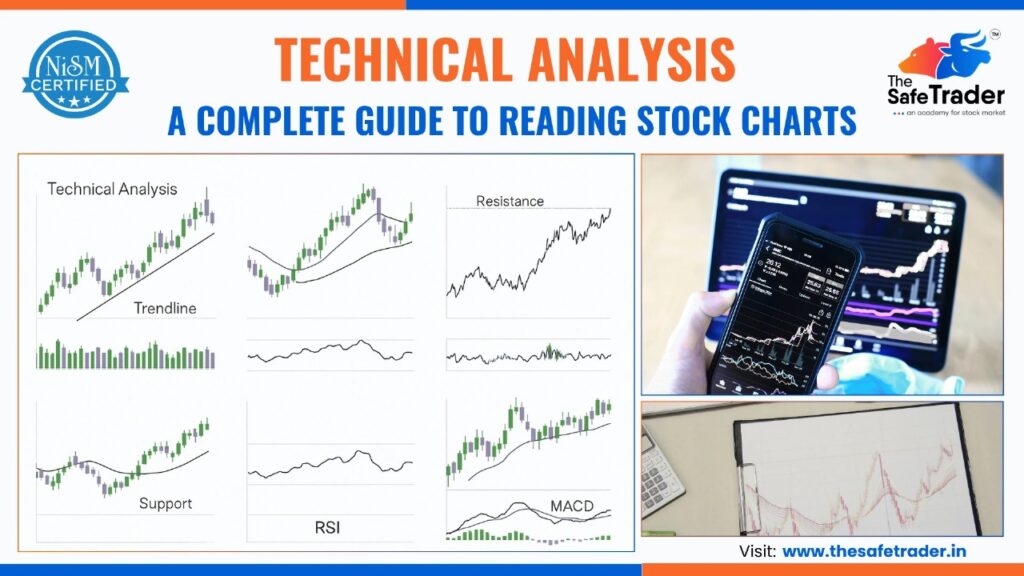
    In an era of fast-paced trading and increasing retail investor participation, understanding the fundamentals of technical analysis can provide a distinct edge. Whether you are day trading, swing trading, or investing long-term, reading stock charts and analyzing patterns is essential for identifying market trends and opportunities.

    What Is Technical Analysis?

    Technical analysis is a method of evaluating securities by analyzing historical price movements and trading volumes. Unlike fundamental analysis, which examines a company’s intrinsic value through financial statements and industry conditions, technical analysis is solely focused on chart data.

    It assumes three core principles:

    1. Market action discounts everything: All known information is reflected in price.
    2. Prices move in trends: Trends persist until they show signs of reversal.
    3. History repeats itself: Patterns in price movements tend to recur over time.

    The Use of Technical Analysis

    The use of technical analysis spans across:

    • Identifying entry and exit points
    • Determining support and resistance levels
    • Recognizing chart patterns
    • Assessing market sentiment

    It is widely used by traders in stocks, forex, commodities, and cryptocurrencies to make data-driven decisions and reduce emotional trading.

    Technical Analysis Chart Patterns

    Recognizing technical analysis chart patterns is fundamental to predicting price movements. Here are some commonly used ones:

    Reversal Patterns

    • Head and Shoulders: Indicates a trend reversal from bullish to bearish (and vice versa).
    • Double Top/Bottom: Suggests a reversal after testing resistance or support twice.

    Continuation Patterns

    • Triangles (Ascending, Descending, Symmetrical): Show price consolidation before a breakout.
    • Flags and Pennants: Short-term patterns indicating a brief pause before the prevailing trend continues.

    Technical Analysis of Stocks

    Applying technical analysis of stocks involves reviewing:

    • Historical price data
    • Short- and long-term moving averages
    • Volume surges at support/resistance
    • Price momentum indicators like RSI or MACD

    By using a combination of these elements, investors can develop a systematic approach to stock selection, timing, and risk management.

    Final Thoughts

    Mastering technical analysis is an ongoing journey that begins with learning how to read charts and recognize key patterns. For new investors, starting with a few indicators and patterns can simplify the learning curve. As experience grows, so will your ability to identify setups and make confident decisions.

    Stay disciplined, always use risk management, and remember: charts tell a story – learn to read it well.

    For the latest market updates and insights, follow The Safe Trader Academy.

    Join Our Free Telegram Channel

  • Is Safe Investing in Crypto Still a Myth in 2025?

    Is Safe Investing in Crypto Still a Myth in 2025?

    Is Crypto Safe to Invest in 2025?

    Cryptocurrencies have long been marked as the financial industry’s future. Millions of Indians entered the digital asset market with the promise of decentralization, transparency, and possibly large returns. However, as of 2025, two significant hacks on WazirX and CoinDCX, two of India’s leading cryptocurrency exchanges, have once again sparked grave worries: Is it really safe to invest in cryptocurrency, particularly in India?

    The Indian ecosystem is still struggling with inadequate regulation, a lack of investor protection, and technical vulnerabilities, despite the fact that the use of cryptocurrencies is expanding globally. On the other hand, a lot of Indian traders are now investigating foreign exchange trading, which is a more developed, highly liquid, and better-regulated market.

    CoinDCX Hack: Insider Involvement, ₹380 Crore Lost

    According to an NDTV report from July 2025, CoinDCX, one of the biggest cryptocurrency exchanges in India, experienced a ₹380 crore security breach. The initial investigation revealed that an insider employee with access to backend systems was responsible for the breach, which was not solely the result of external hacking.

    The accused person was taken into custody by the authorities. But the incident sent a shockwave through the industry. Once renowned for its large user base and funding rounds, CoinDCX is currently under fire for its internal security flaws.

    A resolution, reimbursements, or even updates are still pending for investors impacted by the breach. This demonstrates how precarious investor protection is in India’s cryptocurrency market.

    WazirX Security Breach: Exposure of ₹2,000 Crore in User Funds

    WazirX, another prominent Indian exchange, experienced a massive hack just weeks after the CoinDCX incident. According to The Times of India, a staggering ₹2,000 crore worth of assets were compromised. According to reports, the attackers used technical flaws to obtain access to the platform’s wallet management systems.

    The platform’s slow response, lack of transparency, and uneven communication with impacted users exacerbated this breach. Trust was further damaged when many retail investors experienced account freezes during market turbulence.

    One thing emerged from both situations: the Indian cryptocurrency market is not yet safe or well-regulated enough to provide investor protection comparable to that of other countries.

    Indian Investors Are Now Considering a Safer Option: Forex Trading

    Following these incidents, an increasing number of Indian traders are using foreign forex trading platforms. Forex trading is highly regulated, transparent, and supported by international financial laws, in contrast to cryptocurrency exchanges that operate in gray legal areas.

    The world’s most liquid financial market, the forex market, is open around-the-clock and is where currencies are traded internationally. But the secret is this: Trading forex with Indian brokers differs significantly from trading with foreign brokers.

    Indian Forex vs International Forex: A Clear Comparison

    FeatureIndian Forex TradingInternational Forex Trading
    RegulatorsSEBI, RBIFCA (UK), ASIC, CySEC
    Currency PairsINR-based onlyAll major/global pairs
    LeverageUp to 1:20Up to 1:500
    Tax & GST18% GST + capital gainsNo GST; country-specific tax only
    OnboardingPAN, Aadhaar, income proofMinimal or no KYC
    Platform AccessLimitedMT4, MT5, cTrader
    Fund TransfersStrict FEMA rulesCards, wire, crypto (USDT)
    WithdrawalsSubject to RBI/FEMAFlexible, global transfers
    Strategies AllowedOften restrictedScalping & hedging supported
    LiquidityLocal markets onlyDeep institutional liquidity
    Support HoursIndian business hours24/7 multilingual global support

    Why More Traders Are Moving to International Forex

    The cryptocurrency and forex markets are still severely restricted and overregulated, despite the fact that Indian regulators are gradually moving toward greater clarity in these areas. Domestic forex and cryptocurrency are less appealing due to stringent fund controls, limited trading instruments, tight leverage, and an 18% GST on services.

    On the other hand, there are fewer limitations on Indian traders’ access to international markets thanks to foreign forex brokers. Better leverage, quicker trade execution, and access to a variety of asset classes (currencies, commodities, indexes, and crypto CFDs) are all benefits.

    Additionally, there is no GST on services like commissions or spreads, and depending on broker policies, profits can frequently be kept in the trading account or withdrawn internationally.

    How We Assist You in Beginning – Securely & Rapidly

    We are aware of the hesitancy Indian investors have when switching to global platforms. To make it safe and simple for you to get started, we provide end-to-end support.

    Account setup with the following internationally reputable forex brokers is one of our services. Links to Open a Forex Trading Account.

    Open Free Demo Forex Trading Account:​

    PU Prime
    https://puvip.co/fiaqEf
    Doo Prime
    https://user-ind.dooprimeglobal.com/signup/bnvk-bsuwiqekc-A01
    Alpari(FXTM)
    https://alpari.com/?Referral=71912

    We offer complete support, from registration to funding and even strategy advice, if you would rather have one-on-one help.

    What You Get:

    • Reputable, regulated brokers with a solid international reputation.
    • No paperwork is required.
    • Within minutes, the account was activated.
    • Easy onboarding with knowledgeable assistance.
    • No income or GST restrictions.
    Get Started Right Now

    We can assist you if you are prepared to safely and confidently expand your trading internationally. To start trading with some of the most reputable brokers in the world, open an account with PU Prime, Doo Prime, or Alpari.

    • No records. GST-free. No holding up.
    • Fairness, openness, and authority.

    To begin, get in touch with us right now, or open your account right away by clicking on any of the broker links above.

    For any help
    Call: 9297506666
    Visit:
    www.thesafetrader.in

  • Trump Imposes 25% Tariff On India

    Trump Imposes 25% Tariff On India

    U.S. Imposes 25% Tariff on Indian Exports

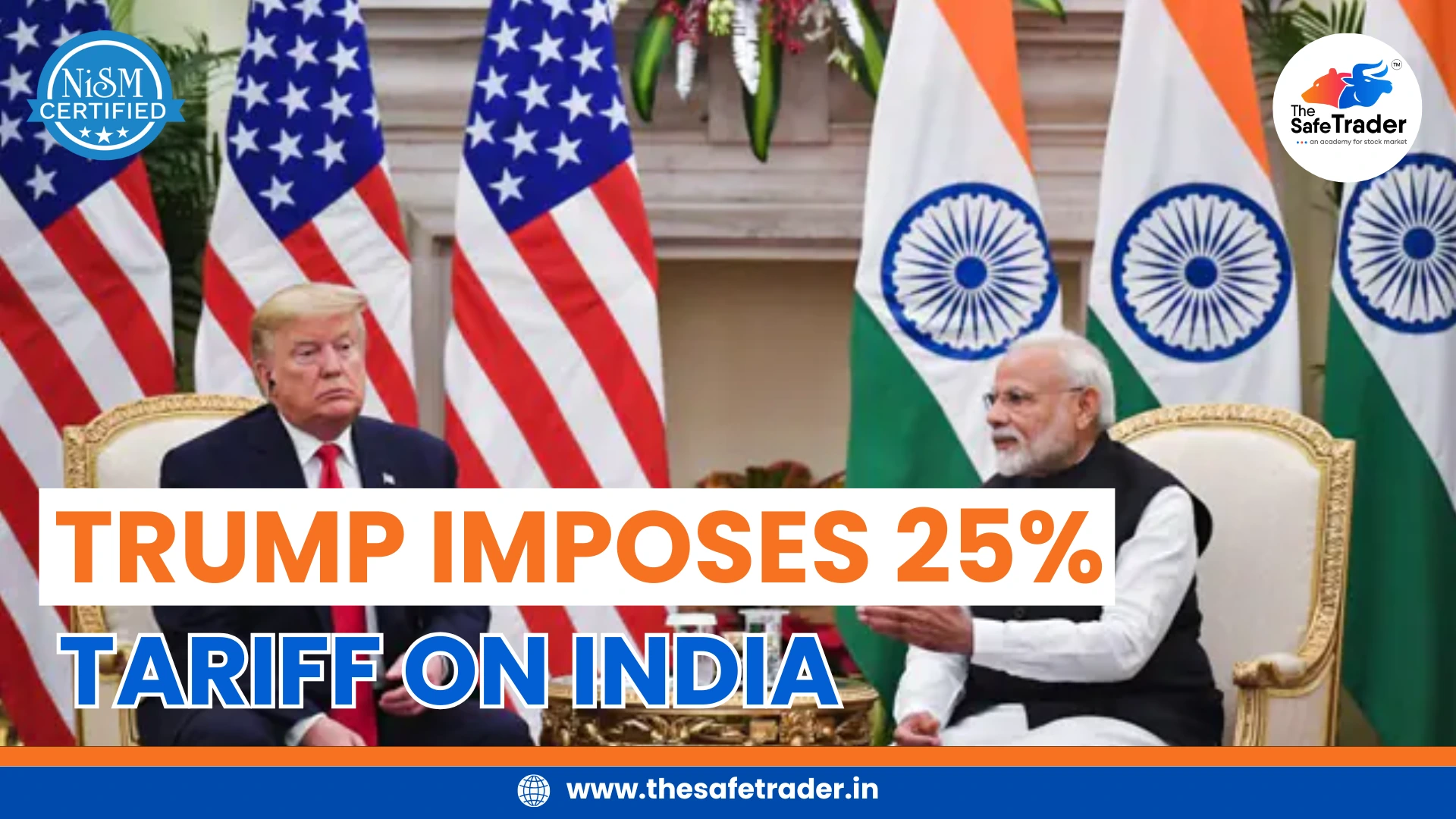
    In addition to an undisclosed fine linked to India’s ongoing defense and energy trade with Russia, U.S. President Donald Trump announced on July 30, 2025, a 25% tariff on almost all Indian imports that would take effect on August 1.

    The effective date was later extended to August 7 by a formal executive order that was signed later, in accordance with larger tariff actions in 68 countries.

    The Reasons Behind the Tariff’s Imposition

    Trump used three main grievances to support the tariff:

    • U.S. business access is restricted by India’s high tariff regime and stringent non-tariff barriers.
    • The United States views India’s ongoing reliance on Russian military hardware and crude as endorsing Moscow’s activities in Ukraine.
    • Trump wants to reduce the bilateral trade imbalance, which will result in a U.S. deficit of almost $45 billion in 2024.

    Trade talks broke down because of a dispute over access to India’s delicate industries, such as dairy and agriculture, despite diplomatic ties and Trump and Modi’s previous public amity.

    Who Is Impacted?

    Nearly all Indian exports are impacted by the new tariff, which is broad and mostly sector-neutral:

    • Steel, textiles, and auto parts are subject to a 25% barrier; some have already been targeted.
    • The cost of electronics and smartphones, including those made in India, is rising, and there are issues with their competitiveness.
    • The U.S. market is putting pressure on seafood, jewelry, and gems, particularly from Gujarat and coastal states.
    • Interestingly, there are still exclusions for critical minerals, semiconductors, and pharmaceuticals-sterling exceptions acknowledged by the US government.

    India’s Response

    India has responded with a measured, calculated policy approach:

    • The government respects the imposition and is “closely studying its implications” while continuing trade talks.
    • India is reviewing sector-specific mitigation plans for export-driven states and getting ready to submit a formal WTO challenge.
    • In response to calls to open sensitive sectors, Commerce Minister Piyush Goyal reiterated India’s commitment to negotiating a fair and balanced trade agreement.

    Impact on the Economy and Market

    India
    • India’s economists predict Export shocks could cause India’s growth to slow by as much as 30 to 40 basis points (0.3 to 0.4%) in FY2026.
    • Indian stocks experienced a slight decline, with indices dropping about 0.6% and the rupee plunging to its lowest level in five months before rising again.
    U.S. & Global
    • The new import taxes are predicted to increase the cost of goods for American consumers, including clothing, automobile parts, and smartphones.
    • Businesses considering “China+1” strategies might think twice about moving production to India because of the country’s lower tariffs than Vietnam (only 20% U.S. rate).

    Summary

    TopicHighlights
    Tariff Rate25% blanket U.S. tariff on most Indian exports, effective Aug 1 (operational Aug 7)
    Penalty ClauseAdded due to India’s Russian energy/defense imports
    Affected SectorsTotal impact across auto, textiles, electronics, gems, seafood
    ExemptionsPharma, semiconductors, critical minerals
    Indian ResponseWTO complaint underway, measured diplomatic strategy, sector-specific supports
    International ImpactU.S. consumers face higher import prices; global supply chains may shift to Vietnam and Bangladesh
    OutlookTrade talks continue; outcome hinges on mid‑Aug delegation and negotiation results

    Conclusion

    A major increase in trade tensions has been signaled by the U.S. decision to impose a 25% tariff on Indian exports, along with a penalty associated with India’s relations with Russia. This is also a strategic turning point, even though it compromises India’s export expansion and depresses investor sentiment.

    Upskilling its export industries, diversifying its markets, and diplomacy will be India’s strongest points. As everyone watches, the result will have an impact on the post-China global trade architecture as well as India-US relations.

    For the latest market updates and insights, follow The Safe Trader Academy.

    Join Our Free Telegram Channel
  • India’s Top 5 Companies by Market Capitalisation

    India’s Top 5 Companies by Market Capitalisation

    Market Capitalisation

    The corporate landscape in India is still undergoing dynamic changes as businesses adjust to global economic trends, financial integration, and digital transformation. A significant reorganization of the Top 5 Most Valuable Companies in the Indian stock market took place as of July 21, 2025, with Bharti Airtel overtaking TCS for the first time.

    This article outlines the latest rankings, verified market capitalisation figures, and strategic reasons behind each company’s current position.

    Key Highlights

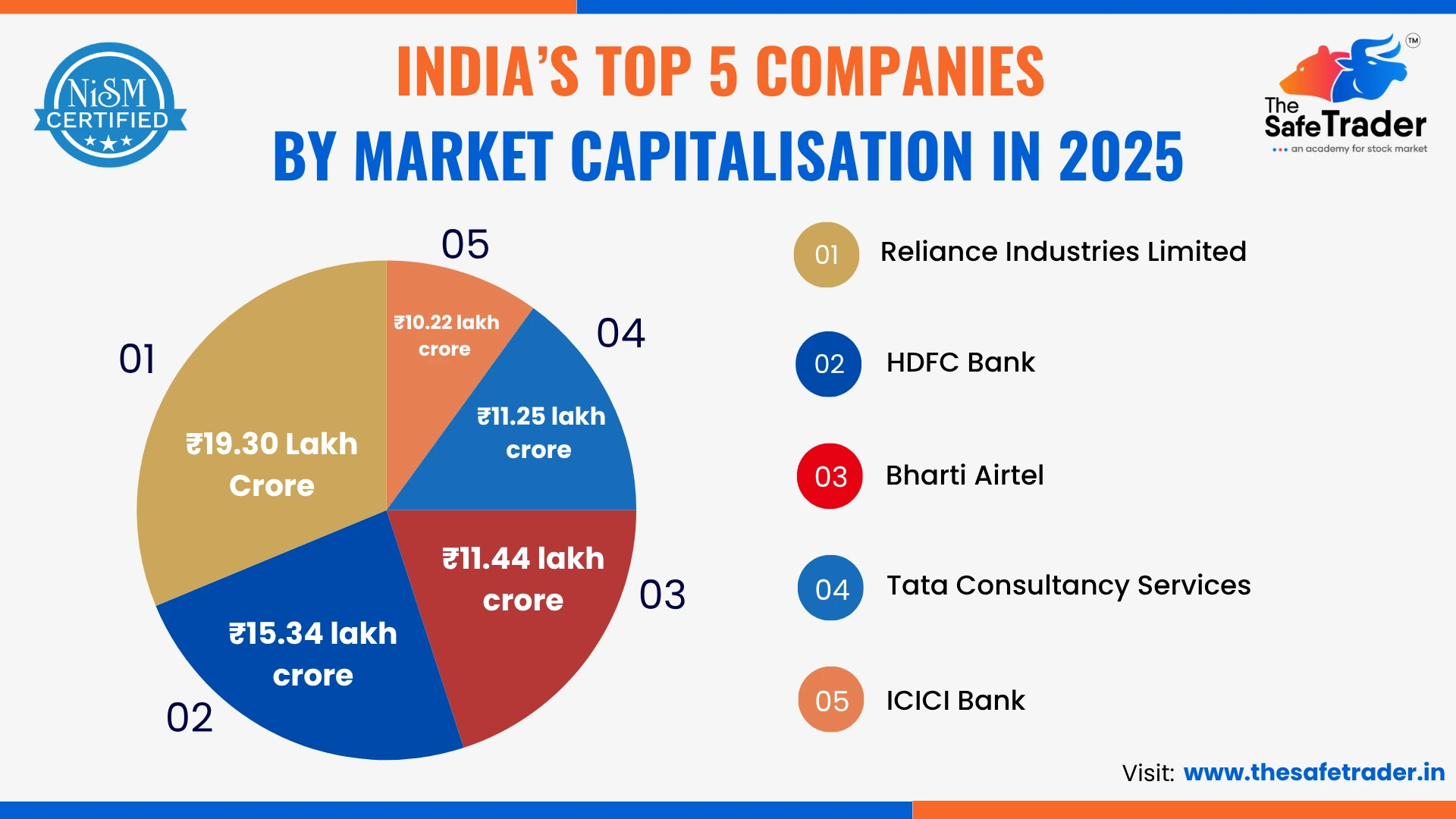
    • Overtaking TCS, Bharti Airtel is now the third most valuable company in India. company in India.
    • At a valuation of ₹19.30 lakh crore, Reliance Industries remains the market leader.
    • HDFC Bank is still firmly in second place with ₹15.34 lakh crore.
    • ICICI Bank enters the Top 5 thanks to its strong credit and digital growth.

    RankCompanyMarket Cap (₹ Lakh Crore)Sector
    1Reliance Industries₹19.30Energy, Digital, Retail
    2HDFC Bank₹15.34Banking & Financials
    3Bharti Airtel₹11.44Telecom & Digital Infra
    4Tata Consultancy Services (TCS)₹11.42IT Services
    5ICICI Bank₹10.22Banking & Finance

    1. Reliance Industries Ltd.

    Market Cap: ₹19.30 Lakh Crore
    Chairman: Mukesh Ambani

    Why It Leads:
    • Bold investments in battery storage, renewable energy, and green hydrogen.
    • Jio’s expansion of digital dominance through the rollout of 5G and the development of an AI ecosystem.
    • Recent forays into aerospace and defense through international joint ventures.
    • Robust retail expansion via e-commerce, Smart Bazaar, and Reliance Trends.

    2. HDFC Bank Ltd.

    Market Cap: ₹15.34 Lakh Crore
    CEO: Sashidhar Jagdishan

    Key Drivers:
    • Strong momentum following the merger with HDFC Ltd., combining leadership in home finance.
    • declared a ₹5 special dividend and a 1:1 bonus issue for July 2025.
    • Retail and SME lending drove the 12% YoY profit growth in the first quarter of FY26.
    • Digital platforms for retail, NRI, and wholesale banking are widely used.

    3. Bharti Airtel Ltd.

    Market Cap: ₹11.44 Lakh Crore
    Chairman: Sunil Bharti Mittal

    Growth Catalysts:
    • Became the first profitable 5G network in India, dominating metro areas.
    • The industry’s highest ARPU (Average Revenue Per User) is ₹209.
    • The data centers of Nxtra, Airtel Payments Bank, and Airtel Ads are expanding quickly.
    • Revenue growth through market expansion in Southeast Asia and Africa.

    4. Tata Consultancy Services

    Market Cap: ₹11.42 Lakh Crore
    CEO: K. Krithivasan

    What’s Working:
    • Robust customer base in manufacturing, retail, and BFSI in more than 40 countries.
    • A deliberate push towards cloud migration, cybersecurity, and GenAI services.
    • keeps low attrition and healthy margins in a demanding global IT environment.
    • The US slowdown had a minor impact on Q1 FY26 revenue, but India and APAC remained stable.

    5. ICICI Bank Ltd.

    Market Cap: ₹10.22 Lakh Crore
    MD & CEO: Sandeep Bakhshi

    What’s Behind the Rise:
    • The first quarter of FY26’s net profit was 15.5% YoY higher than analysts had predicted.
    • The greatest digital lending platform on the market, offering instantaneous approvals without paper.
    • Quick expansion in corporate, auto, and credit card lending.
    • Excellent risk management and asset quality, with a gross non-performing asset (NPA) below 3%.

    Final Thoughts

    Today’s leading Indian businesses are diverse, tech-driven, and globally oriented. The rise of telecom and fintech behemoths portends a time when market leadership will be determined by data, infrastructure, and financial accessibility.

    The Top 5 companies are the cornerstones of India’s $5 trillion economic ambition, from Reliance’s diverse empire to HDFC and ICICI’s push for digital banking, from Airtel’s 5G success to TCS’s global tech base.

    For the latest market updates and insights, follow The Safe Trader Academy.

    Join Our Free Telegram Channel

  • Follow These 5 Steps to Be a Disciplined Trader

    Follow These 5 Steps to Be a Disciplined Trader

    Master the Art of Being a Disciplined Trader Today

    Becoming a disciplined trader leads to long-term success.

    Trading requires more than just charts and numbers; it also calls for discipline, planning, and-above all-a positive mindset. If you’ve been inconsistent or struggling to make emotional decisions, it’s time to step back and adjust your approach.

    We at The Safe Trader Academy believe that self-awareness, structure, and education are the keys to becoming a successful, disciplined trader. Our trainers, who have years of experience, have created simple yet effective rules that all traders must follow to avoid expensive mistakes and advance gradually.

    In order to become a disciplined trader, one needs to form habits that enhance not only technical skills but also mental toughness, risk management, and trade clarity. Let’s examine the 5 Golden Rules that all traders should adhere to in order to develop discipline and success, as stated in our training materials:

    1. Create a Trading Schedule

    Set a trading time and follow it. For instance, limit your trading to the first two hours of the market. This enhances concentration and helps avoid overwork and rash trading later in the day.

    2. Avoid trading on emotions

    If you’re feeling upset, stay away. It is better to miss a trade than to make a rash choice. The two biggest capital destroyers, revenge trades and over-leveraging, are the results of emotional trading.

    3. Set a Loss Limit

    Establish a limit on the number of stop losses you will tolerate in a given day. For example, halt trading for the day if three stop losses occur consecutively. This preserves your money and your mental well-being.

    4. Keep a Journal of Every Loss

    Make a note of any trades that don’t work out for you. Recognize the reasons behind its failure: was it emotional bias, incorrect analysis, or poor entry? The quickest way to get better and stop making the same mistakes is to keep a journal.

    5. Avoid Comparing Your Trades

    Your trading experience is distinct. Don’t compare other people’s mark-to-market (MTM) to yours. Each trader has a unique psychology, strategy, and amount of capital. Wait for your breakthrough while concentrating on your own process.

    Why Is The Safe Trader Academy the Greatest Choice?

    Choosing the right stock market institution is the first step toward financial independence. The Safe Trader Academy provides a practical, immersive, and real-time experience in addition to theory, preparing every student to become a successful, confident trader. More than 5,000+ students in India and abroad have trust in us. We rank among the best stock market training academy in India.

    Why Choose The Safe Trader Academy?

    ✅ Tools & Software for Trading & Investing
    ✅ Fundamentals of the Indian Share Market
    ✅ Equity Investment
    ✅ Technical & Fundamental Analysis
    ✅ Futures & Options
    ✅ Forex & Commodity Trading
    ✅ Effective Intraday Trading Strategies
    ✅ Available Online & Offline Classes
    ✅ Three months of live market analysis and handling
    ✅ Over 500 real-time market assignments
    ✅ One-on-one conversations with our CEO and trainer
    ✅ Zoom recordings for each class

    We’re not just another trading institute – we are India’s fastest-growing stock market training academy, with a presence across major cities.

    The Safe Trader Academy is glad to offer both online and offline share market courses to students all over India. We offer a variety of options to meet your needs, regardless of if you would rather learn from the comfort of your home or attend one of our centers for in-person instruction.

    For students from important Indian cities, we provide expert-led online stock market training courses, such as:

    Stock Market Courses In Hyderabad | Stock Market Courses In Delhi | Stock Market Courses In Mumbai | Stock Market Courses In Pune | Stock Market Courses In Bengaluru | Stock Market Courses In Ahmedabad | Stock Market Courses In Chennai | Stock Market Courses In Visakhapatnam | Stock Market Courses In Vijayawada | Stock Market Courses In Patna | Stock Market Courses In Bhopal | Stock Market Courses In Lucknow | Stock Market Courses In Kolkata | Stock Market Courses In Thiruvananthapuram | Stock Market Courses In Warangal | Stock Market Courses In Tirupati | Stock Market Courses In Gurugram

    Whether you’re searching for the best share market courses or need convenient online stock market classes, The Safe Trader Academy has everything you need in one location.

    “At The Safe Trader Academy, these are not just tips-we embed these practices into every training session. From beginner to pro, our students follow a proven structure that builds real trading discipline and consistency.”

    Visit : www.thesafetrader.in
    Contact us : +91 9297506666