Thesafetrader

Author: thesafetrader.in

  • Why Choose Safe Trader Academy?

    Why Choose Safe Trader Academy?

    The Safe Trader Academy

    When it comes to mastering the art of stock market trading, choosing the right academy is essential. The Safe Trader Academy has become one of India’s No.1 Best Stock Market Training Institutions, recognized for its comprehensive courses, experienced mentors, and proven track record of success. Additionally, it is widely regarded as Hyderabad’s top choice for stock market education. Here’s why it stands out as one of the top choices for aspiring traders.

    1. NISM Certified and AMFI Registered Trainers

    At The Safe Trader Academy, we prioritize quality education by offering training from NISM Certified Research Analysts and AMFI Registered Mutual Fund Distributors. These certifications ensure that our mentors bring up-to-date, credible, and professional insights into the classroom, providing students with the highest standards of training in the stock market.

    2. Over 2,500+ Successful Students Trained

    With more than 2,500+ students trained and a growing presence across India with 5+ branches, The Safe Trader Academy has helped countless individuals transform into skilled and confident traders. Our alumni’s success stories are a testament to the effectiveness of our training programs, and we continue to equip new students with the tools they need for success.

    3. Flexible and Comprehensive Learning Options

    Whether you’re a beginner or an experienced trader, we offer courses that cater to your specific needs. Our curriculum covers everything from basic trading principles to advanced techniques like Options Trading, Forex Trading, Crypto Trading, and Equity Investing.

    • Learn from Basic to Advanced: Our structured approach ensures that students can start from scratch and gradually progress to advanced trading strategies.
    • 200+ Assignments: With practical assignments, students are able to apply what they’ve learned and refine their skills.
    • Learn in Multiple Languages: Courses are available in English, Hindi, Telugu, and Kannada, making it accessible to a wider audience across India.

    4. Direct Mentorship from Our CEO

    One of the standout features of The Safe Trader Academy is the direct mentorship from our CEO. This exclusive opportunity allows students to gain invaluable insights from an industry leader, learn about the latest market trends, and get personalized advice to shape their trading journey. It’s a unique offering that sets us apart from other training institutions.

    5. Live Market Support and Daily Tips

    At The Safe Trader Academy, we ensure that our students stay on top of market trends. Through live market support and daily trading tips (especially for Options & Forex), students are able to stay updated with real-time developments. This hands-on support helps build their confidence and enhances their decision-making skills.

    6. Access to Zoom Recordings and Flexible Batch System

    We understand that life can get busy, and flexibility is important. That’s why we offer Zoom recordings of all classes, so students never miss out on important lessons. Moreover, our flexible batch system allows you to revisit courses as many times as needed without incurring additional costs. This ensures continuous learning and growth at your own pace.

    7. Exclusive Telegram Channels for Community Interaction

    As part of the course, students gain access to our official Telegram channels, where they can interact with peers, share insights, ask questions, and keep up with the latest market updates. This creates a community of like-minded individuals who support and motivate each other in their trading journey.

    8. Real Classroom Exposure

    At The Safe Trader Academy, we believe in transparency and interaction. Our real classroom exposure offers students the chance to walk in, observe, and directly communicate with our current students and mentors. This open environment fosters collaboration and provides an authentic feel of what it’s like to be part of our learning community.

    Why Choose The Safe Trader Academy?

    • Multiple mentors to guide you throughout your learning journey.
    • Comprehensive curriculum from basic to advanced levels.
    • Direct mentorship from our CEO for personalized guidance.
    • Live market tips and daily support for real-time learning.
    • Zoom recordings of missed classes to ensure you never fall behind.
    • Pay once, learn multiple times with unlimited access to course material.
    • Access to official Telegram channels for community learning.

    Conclusion

    The Safe Trader Academy, recognized as India’s No.1 Best Stock Market Training Institution and Hyderabad’s top choice for stock market education, is not just another training institute; it is a trusted partner in your journey to becoming a successful trader. With a strong emphasis on practical learning, direct mentorship, and a flexible learning environment, we equip our students with the knowledge and tools they need to thrive in the dynamic world of stock trading.

    Whether you’re just starting or looking to refine your trading skills, The Safe Trader Academy is your one-stop destination for mastering the stock market.

  • Why 93% of Retail Traders Lose Money in Options Trading?

    Why 93% of Retail Traders Lose Money in Options Trading?

    Why 93% of Retail Traders Lose Money in Options Trading

    There was a shocking report from SEBI (Securities and Exchange Board of India) stating that 93% of retail traders in the F&O (Futures & Options) segment are incurring losses. These are not just figures but instead depict the actual happenings behind those green screenshots and success stories flooding your feed. 

    Adding to that, more telling statistics at the state-level were revealed. The top states with maximum trading losses are:

    1. Telangana,
    1. Andhra Pradesh,
    1. Karnataka,
    1. Tamil Nadu.

    These are not backward states. They are the home of several of India’s tech hubs and business centers, and some of the highest per capita income groups reside here. So how come even these educated and financially literate populations have not been able to make it in the stock market?

    The Illusion of Success in Trading

    Let’s be honest. Social media has made trading look like a “laptop lifestyle.” Quick profits. Fancy setups. Flashy cars. But behind that illusion is a reality full of anxiety, losses, and debt.

    The truth is, trading is simple—but not easy.

    According to Mallinath Mulage, Founder & CEO of The Safe Trader Academy, the problem lies not in the stock market itself but in the mindset, approach, and education level of traders.

    Below is a deeper dive into his 20 critical observations—real reasons why traders are consistently losing money.

    1. Traders don’t spend enough time to learn

    A lot of people go for options trading after getting a glimpse of the venture from some YouTube videos or a webinar. But options trading is not something that can be learned over the weekend. It is a combination of market knowledge, technical analysis, psychology, and strategy-making.

    Would you ever want to board a plane having learnt just a couple of Instagram Reels about flying?

    2. Traders want to make quick money

    People are drawn to options on account of the potential for high returns. Yet high returns imply high risk. The urge to double money in one trading day leads traders to ignore the basic rules of trading and indulge in impulsive trades.

    Fast money mindset = fast losses. 

    3. Traders are greedy

    Traders restricting their positions, yet hoping for more profits, almost always are losers as positions reverse and turn against them. Many traders don’t book profits; instead, they double the stake, hoping for recovery on a trade that has already gone against them.

    Greed allows you to stay in the market longer than you ever should. 

    4. Emotional

    Fear, greed, hope, and regret are the four demons of trading. Every time emotions step into the decision-making process, discipline is thrown out of the window. Most retail traders fail to have a plan; they merely react to every single candle on the chart.

    Emotion + money = disaster. 

    5. Not gaining required skills

    Successful trading is about multi-skilled learning: reading charts, understanding market sentiment, knowledge of risk management, and so on. Skipping these steps is like going to war without the weapons.

    “Skill pays the bills.”

    6. Not maintaining stoploss

    Stop loss is your safety net: not placing it or moving it, hoping that the trade will “come back,” is perhaps the fastest way to blow your account.

    A stop loss is not an option; it is a matter of survival.

    7. Naked options buying

    Most new traders just buy calls or puts without bothering about volatility (VIX) or time decay (theta) or direction. Buying options with not a care about strategy is akin to gambling at whatever roulette does.

    Trades with low probabilities generate high stress.

    8.Wrong entry and wrong exit

    It is common to enter too late or exit too early or late. Without clear rules about when to enter and when to exit, you will be gambling.

    It is not timing that is everything; it is the only thing.

    9. Don’t want to learn from the mistakes

    Too many traders make the same mistakes over and over again: leverage too much, hold onto a losing trade, hold on for news… Past trades are never reviewed, so nothing changes.

    Insanity is repeating the same thing over and over and expecting different results.

    10. Overtrading

    Too many trades within a day cloud a trader’s judgment and drain him emotionally. Some traders refuse to stop even while on a losing streak; they instead continue trading to “recover.”

    Overtrading=death by a thousand cuts.

    11. Depends on tips

    People blindly follow Telegram/WhatsApp tips without understanding the rationale behind it. Even if a tip works once in a blue moon, a false tip would wipe out weeks of profit.

    If tips worked, then everyone would be a billionaire.

    12. Social media influencer

    Instagram reels and YouTube videos flash across the screen with huge profits but hardly show losses. It does not represent what trading truly is, thereby setting up unrealistic expectations.

    Social media shows highlights, but never the actual game.

    13. No Trading Journal

    Not maintaining one means you don’t know what works for you and what doesn’t. A trading journal inculcates self-awareness and hones your edge.

    What gets measured gets improved.

    14. No Mentor or Trade Buddy

    Without someone to guide you, it’s likely you will take much longer to learn or, worse, pick up a few bad habits. A mentor will help you avoid rookie mistakes and hold you accountable. 

    All pros were once beginners, and so should you.

    15. No Back testing

    You need to test your strategy on historical data before going live. If you don’t know how your set-up is performing over maybe 100 plus trades, you are literally trading in the dark.

    Never risk real money on untried strategies.

    16. Not able to find the right institute to learn offline

    There’s every online video and free content and then there is the structured in-depth offline education hard to find. They even lack hands-on guidance. 

    Learning is as personalized as it comes.

    17. Taking risk beyond the risk appetite

    Big bets might hit big on a single trade jackpot; however, jackpots are often lost in each losing trade. Be in it for life, not just greedily.

    Respect the risk or you’ll learn it the hard way from the market. 

    18. Keep high expectations

    Living on that daily dream of trading wages with little money leads to much agony and poor decisions. Trading is playing a game of probability, not a game of certainty. 

    You don’t harvest everyday; you plant, wait, and then reap. 

    19. No risk management

    It will result in no risk per trade or exit point; traders will thus be wiped out. Risk management is what keeps one alive in trading. 

    The first rule of trading: Don’t lose big. 

    20. No Money Management 

    Insufficient knowledge of capital management on trade amounts, withdrawal amounts, and re-investment amounts can bring down even the best strategies. 

    It is not how much you make. It is how much you keep.

    A Message from The Safe Trader Academy

    We at The Safe Trader Academy are devoted to overturning the 93% loss statistic. Working offline and online, we have trained traders for over five years, helping them move from losses to a stable performance via structured education, real-time trading practice, and one-on-one mentorship.

    The Academy’s Focus:

    ✅ Strategy Development

    ✅ Risk & Money Management

    ✅ Trading Psychology

    ✅ Live Assistance in the Market

    ✅ Backtesting & Journaling

    ✅ Personalized Mentorship

    Conclusion: Trading Is Not a Shortcut but a Skill

    For those who have lost, the markets are not punishing you; they are testing you. With the right education, mentorship, and mindset, you can turn the game in your favor.

    🔁 Learn > Practice > Refine > Earn

    Don’t be part of the 93%. Be the exception.

  • Gold Prices Hit All-Time High, Surpass ₹96,000 per 10 Grams Mark

    Gold Prices Hit All-Time High, Surpass ₹96,000 per 10 Grams Mark

    Gold Prices Hit All-Time High, Surpass ₹96,000 per 10 Grams Mark

    Gold prices soared to an all-time high on Friday, 11 April, 2025, crossing the ₹96,000 per 10 grams threshold for the first time in history. The value of the metal skyrocketed by ₹6,250, based on intense jewellery buying and speculative interest by investors against the background of growing worldwide uncertainties.

    Price Movement & Market Context

    Gold with 24K purity reached ₹96,450 per 10 grams, which is a record high. The steep rise of ₹6,250 in a single day brought an end to a four-day losing spree, the highest single-day increase in more than two months. Gold futures also scaled new peaks, with June delivery contracts rising to ₹93,736 per 10 grams on the Multi Commodity Exchange (MCX).

    Factors Driving the Surge

    The surge in gold prices comes amid escalating global trade tensions, particularly between the U.S. and China. U.S. President Donald Trump’s decision to increase tariffs on Chinese imports has sparked fears of a full-scale trade war,boosting demand for gold as a safe-haven asset. The increasing probability of an economic downturn, weakening dollar, and U.S. Treasury selloff have also fueled demand for gold on both the domestic and foreign fronts.

    Silver Price Surge

    Silver prices also increased sharply, rising ₹2,300 to ₹95,500 per kilogram. The rise in the silver market is a reflection of the increase in gold, fueled by global uncertainties and the rush to precious metals.

    Global Gold Market Trends

    Gold prices recorded a new record high of $3,237.39 an ounce in the international market with Comex gold futures touching a high of $3,249.16 an ounce during the Asian market trading hours. Geopolitical uncertainties, such as the U.S.-China trade war, are still propelling gold’s attraction as a haven asset. Emerging market central banks have been acquiring gold at an unprecedented rate, further driving demand.

    Expert Opinions

    Financial analysts and companies such as UBS are forecasting sustained strength for gold over the next few months. Gold will continue to be a fundamental asset during uncertain times, spurred by global economic problems and continued diversification out of the U.S. dollar, UBS believes.

    What This Means for Investors

    For investors, the present spike in gold prices is both opportunity and risk. While gold is still a good hedge against economic turmoil, investors who are new to the market must exercise caution since prices are at record levels. Investors should plan on the long-term and keep themselves updated on developments around the world.

    Conclusion

    Gold’s remarkable rise above ₹96,000 per 10 grams underscores its role as a key safe-haven asset in times of uncertainty. With geopolitical tensions, economic anxiety, and a declining U.S. dollar fueling its advance, gold can expect to experience robust demand in the coming months.

  • Trump Announces 90-Day Pause On Reciprocal Tariffs, Except China

    Trump Announces 90-Day Pause On Reciprocal Tariffs, Except China

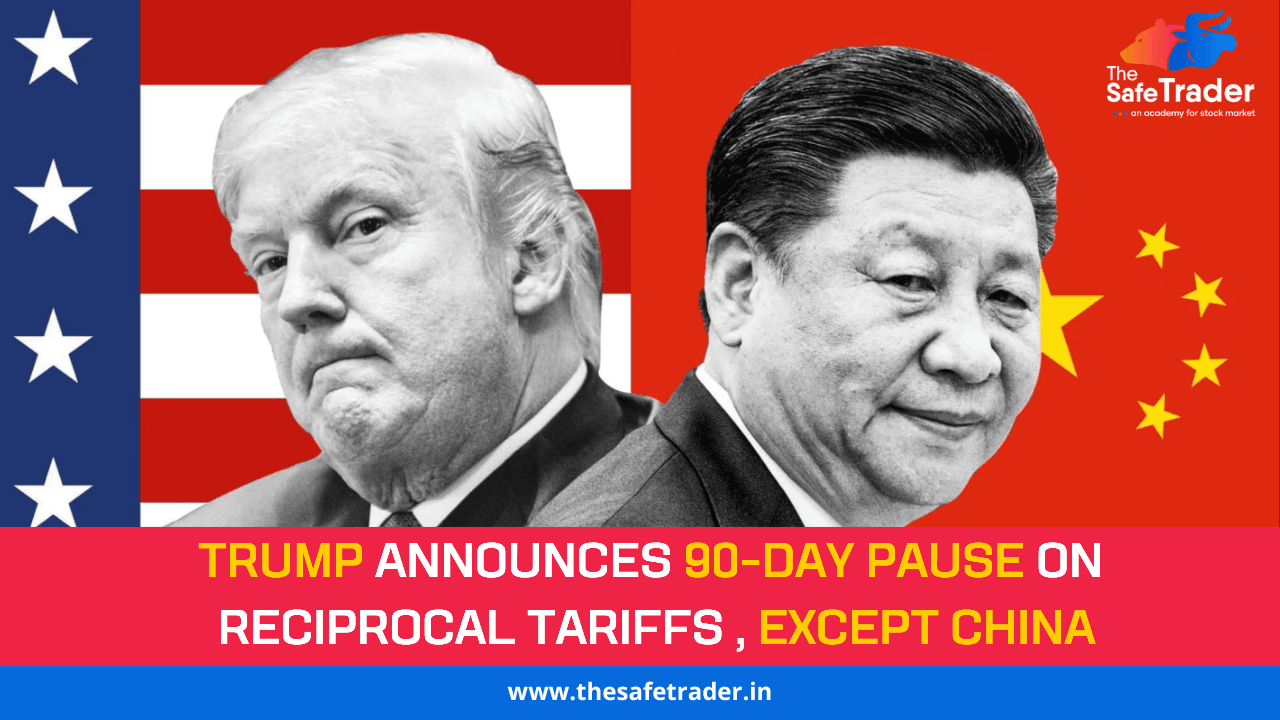
    On Wednesday, in an unexpected shift of strategy, U.S. President Donald Trump announced a 90-day pause on sweeping tariffs for most countries, except China. Initially, the tariffs were introduced to combat what Trump perceived as unfair trade imbalances. However, after intense pressure from business executives and political figures, and growing concerns about the potential repercussions of a global trade war, Trump decided to soften his stance.

    The pause, which will last for 90 days, will witness a substantially lower tariff of only 10 percent on nations that had negotiated with the U.S., while China will witness a much more confrontational tariff hike. Trump imposed higher tariffs on China to a whopping 125 percent from the already announced 104 percent. This action is largely a response to China’s trade policies, which Trump has over and over again called “unfair” to the U.S. economy.

    Why the Change of Heart?

    The sudden reversal followed increasing unease in the U.S. Treasury Department about the condition of the bond market. Treasury Secretary Scott Bessent and White House economic aides allegedly briefed Trump on the spreading selloff in U.S. Treasury bonds, which had sent shudders through world financial markets. For days, Trump had defied demands from both fellow Republicans and business leaders to stand down from the tariffs, citing the imperative of addressing the trade imbalance. But it appears that the turmoil in the bond market was too large to overlook.

    In his announcement, Trump acknowledged that the decision to pause the tariffs was made on impulse. “The bond market is very tricky… but yeah, I saw last night where people were getting a little queasy,” he remarked during a press briefing. This comment suggests that the president’s decision wasn’t fully planned out, but rather a reaction to the emerging financial instability.

    What Happened in the Markets?

    The tariff pause news had a sudden and dramatic impact on U.S. financial markets. Shares rallied as investors welcomed survival of the creditors’ plan. But within minutes of the announcement, the Dow Jones Industrial Average rose by about 2,500 points, reaching a near 8 percent daily increase. Nasdaq, the tech-heavy index, jumped 12.2 percent, its best performance in 24 years. The S&P 500 also rose by a big 6.0 percent to 5,281.44 points.

    Besides the rally in the stock market, oil prices rose over 4 percent as the hope of easing trade tensions cut down on worries about a global economic slowdown. The U.S. currency also gained strength as investors felt a renewed optimism that had previously been worried about the devastating impact of a prolonged trade war.

    These market fluctuations highlight just how closely interwoven tariffs, trade policy, and investor sentiment are. The rapid fluctuations in bond markets and the increased fear of recession were all it took to get the United States administration to move, and by doing so, Trump gave the world economy a welcome respite, if only temporarily.

    The Continued China Factor

    Even with the relief provided to most nations by the temporary tariff reprieve, Trump’s move to raise tariffs on China represents a continued point of contention in the trade war. Trump’s tough talk against China, especially his remarks regarding President Xi Jinping’s pride and the nation’s purported manipulation of world markets, indicates that the trade war with China will continue to be a point of emphasis in U.S. foreign policy.

    The 125 percent tariff hike is viewed as an overt effort to pressure China into agreeing to a good trade agreement with the U.S. Though Trump was hopeful that China would ultimately “figure it out,” the dramatic rise in tariffs might also boomerang by aggravating U.S.-China tensions further and damaging the global trading system.

    Conclusion: Temporary Relief Amid Continued Uncertainty

    Trump’s announcement to pause tariffs for 90 days offers a temporary sigh of relief for global markets, particularly the U.S. stock market, which had been under intense pressure from trade-related concerns. The dramatic market rebound following the news signals the significance of the tariff pause in alleviating investor fears of an impending global recession or trade war.

    But this action does not solve the root problems of U.S.-China trade relations. The tariff hike on China indicates that Trump’s tough approach to China will continue, and the trade war is far from over. In addition, although a pause in tariffs could bring temporary stability, the long-term impact on global trade and the economy is unclear.

    As financial markets respond to this latest turn of events, one thing is certain: the fate of the trade war will rest largely in the hands of the future of U.S.-China talks and the wider geopolitics. Investors will be watching closely over the next 90 days, praying that the temporary reprieve from tariffs will be sufficient to avoid a wider economic crisis.

  • China Strikes Back: 84% Tariffs on U.S. Goods

    China Strikes Back: 84% Tariffs on U.S. Goods

    China Strikes Back

    In a dramatic intensification of the U.S.-China trade war, China has said it will impose 84% tariffs on U.S. products, a major turn in the current conflict between the two world’s largest economies. The action follows directly on the heels of the U.S.’s recent imposition of 104% tariffs on Chinese imports, a move that could signal a further intensification of economic tensions with potentially global implications.

    The Catalyst: U.S. Trade Policies and the Escalating Tensions
    The tensions between the U.S. and China have been brewing for decades, fueled mainly by fear of trade deficits, intellectual property theft, and the economic practices of China. Recent months have seen the U.S. ramp up its actions to push China to address these concerns, levying massive tariffs on Chinese goods.

    China, for its part, has retaliated in turn with measures of its own, leading up to the current announcement of an 84% tariff on American goods. The move is as much a political as an economic maneuver, reasserting China’s position that it will not be bullied into responding to U.S. pressures.

    Impact on the Global Economy

    The instant impact of this tariff hike is being experienced in world financial markets. Investors are being cautious, and leading share indices in the U.S. and Europe have witnessed falls following increasing uncertainties. The stock market volatility reflects the larger concerns surrounding the world economy.

    Oil prices have also seen steep declines, as the trade war remains to hang over the prospects of global growth. In China, the yuan dropped to its lowest level in close to two years, raising concerns of a continued slowdown in the second-largest economy in the world.

    The Long-Term Outlook: A Prolonged Economic Battle

    The future is uncertain. While neither country has indicated a willingness to fold, the economic impact of these rising tariffs could be catastrophic. Experts see the prolonged trade wars affecting businesses and consumers in a big way.

    For multinational corporations, this translates into increased costs of goods, supply chain disruptions, and possible changes in market dynamics. For consumers, it might mean increased prices for common items, especially in sectors such as technology, automobiles, and consumer goods, where Chinese and American companies have strong trade relationships.

    The Role of Governments and the Potential for Negotiations

    Although the situation is still tense, there is still a possibility of a diplomatic solution. There have been several rounds of talks between the U.S. and China throughout the years, and even though there is currently a standoff, there are still possibilities for talks that can diffuse the conflict. Any such agreement, however, would involve major concessions from both parties, and thus a solution is unlikely in the near future.

    What Should Investors and Businesses Do?

    In light of these developments, investors are advised to exercise caution and maintain diversified portfolios to shield themselves from the volatility triggered by the trade war. For businesses, especially those involved in global supply chains, it’s crucial to reassess operational strategies and explore alternative sourcing options to minimize the impact of these new tariffs.

    The threat of further escalation cannot be ruled out, and businesses need to prepare for a longer duration of uncertainty. Flexibility and an emphasis on long-term objectives will be the key as the global economic scenario continues to change.

    Conclusion

    China’s imposition of 84% tariffs on U.S. goods marks a significant chapter in the ongoing trade war, with profound implications for both nations and the global economy. While the full impact remains to be seen, it’s clear that the stakes are high, and the outcome of this conflict will shape global trade for years to come. As businesses, investors, and governments navigate this uncertain terrain, it’s more important than ever to remain informed and adaptable in the face of these escalating trade tensions.

  • India Buys 26 Rafale Marine Aircraft Deal

    India Buys 26 Rafale Marine Aircraft Deal

    The Safe Trader

    In a significant step towards bolstering its naval power, India has approved a ₹63,000 crore agreement to buy 26 Rafale Marine fighter jets from France. The deal, one of the largest-ever defense acquisitions in history, would substantially increase the operational and fighting capability of the Indian Navy, particularly in the field of carrier-based operations. This transaction symbolizes India’s efforts to indigenously update its military capability with the state-of-the-art technology needed to counter the emerging strategic imperatives of the Indo-Pacific theater of operations.

    Why the Rafale Marine Aircraft?

    The Rafale Marine, a variant of the renowned Rafale fighter jet, has been specially crafted for carrier operations. The multi-role jets will replace the ageing MiG-29K fleet of aircraft used by the Indian Navy. The advanced capabilities of the Rafale Marine, such as its versatility and weapons payload, make it a perfect fit for the Navy’s changing requirements.

    With a maximum speed of more than Mach 1.8 and the capacity to perform a variety of missions, such as air dominance, ground attack, and anti-ship missions, the Rafale Marine will grant the Indian Navy greater flexibility and strike power. The aircraft will be fitted with state-of-the-art avionics, radar, and weapon systems, including the Meteor missile, one of the world’s most advanced air-to-air missiles, and precision-guided weapons for anti-ship missions.

    What the Deal Includes

    As part of the agreement, India will be purchasing 22 single-seater Rafale Marine combatants and 4 twin-seater trainer models, which will be used to train Navy pilots. The aircraft will be deployed on the INS Vikrant and INS Vikramaditya aircraft carriers, greatly increasing their operational capability. The addition of sophisticated weaponry will also increase the Navy’s capability to protect Indian maritime borders and project power globally.

    The agreement also involves comprehensive training for Indian pilots and maintenance staff, so the Indian Navy would be able to effectively operate such advanced jets. The carrier suitability of the Rafale Marine is an important feature, enabling efficient integration into the current naval fleet and operations in India.

    Enhancing India-France Defense Relations

    This transaction is a huge boost to India-France defense ties. France has long been India’s defense partner, providing cutting-edge technology like the Rafale combat jets for the Indian Air Force. This transaction boosts the two countries’ defense collaboration to a whole new level and reflects their common strategic interests as well as deepening regional security.

    The purchase is also in line with the Indian ambition of decreasing reliance on foreign defense producers while at the same time securing its ties to major global defense allies. Acquiring the Rafale Marine jet fighter is an indication of increased Indian interest in upgrading its military infrastructure with superior technology available on the market.

    A Major Step for Indian Naval Power

    This acquisition is a major step towards India’s plan to modernize its naval capabilities and guarantee its supremacy within the Indo-Pacific region. With rising tensions in the region, especially with China’s increased maritime presence, India’s capacity to project power via a modernized Navy is imperative. The Rafale Marine will not just strengthen India’s defense but will also serve as a strong deterrent against any possible threats.

    The acquisition of the Rafale Marine aircraft is a key part of India’s larger defense modernization, which includes the induction of advanced naval platforms and weaponry. It is a clear indication of India’s intent to maintain a robust and technologically advanced military capable of safeguarding its maritime interests and ensuring peace and stability in the region.

    Conclusion: A Game-Changer for Indian Naval Aviation

    The ₹63,000 crore deal to acquire 26 Rafale Marine fighter jets marks a new chapter in India’s naval modernization journey. With the integration of these advanced aircraft, the Indian Navy will be better equipped to handle complex operations across vast maritime territories. The Rafale Marine aircraft will provide the Navy with enhanced flexibility, operational reach, and superior strike capabilities, transforming it into a force to be reckoned with.

    As India continues to grow its defense infrastructure and strengthen its partnerships with key international allies, this acquisition will play a central role in shaping the future of India’s naval power. The Rafale Marine will ensure that India remains prepared to address the security challenges of the 21st century, enhancing its strategic position in the Indo-Pacific region and beyond.

    This deal is not only a major defense acquisition but a clear indication of India’s growing influence and commitment to ensuring its national security in an increasingly volatile global landscape.

  • MetaTrader 4 Vs MetaTrader 5

    MetaTrader 4 Vs MetaTrader 5

    Forex traders regularly face the tough decision of which platform to choose: MetaTrader 4 Vs MetaTrader 5. This program is designed by MetaQuotes Software, where both platforms provide good trading features but are meant to serve different trading needs. In this guide, we will distinguish between MetaTrader 4 and MetaTrader 5 in order to expose the better one to you.

    MetaTrader 4 Vs MetaTrader 5: A Comparison of Features

    What is MetaTrader 4 (MT4)?

    Released in 2005, MetaTrader 4 quickly adopted the role of being an industry standard for forex trading. It is known for its user-friendly interface, myriad charting mechanisms, and support for automated trading through Expert Advisors (EAs). MT4 is still relatively popular, especially among forex traders who desire something straightforward and reliable.

    What is MetaTrader 5 (MT5)?

    Introduced in 2010 as an advanced multi-asset trading platform, MetaTrader 5 (MT5) was designed to give traders more freedom in their trading. MT5 was built from the ground to be far more than a forex trading platform, as MT4 was. MT5 supports trading in forex, stocks, commodities, and futures. Improvements in timeframes, order types, and backtesting for algorithmic traders are also included.

    Key Differences Between MT4 and MT5

    While both platforms share similarities, they have distinct features that cater to different types of traders. Below are the key differences:

    When to Use MetaTrader 4 (MT4) 

    • If you are a forex-only trader, MT4 is sufficient for your needs.
    • If you rely on custom indicators and Expert Advisors, many traders still prefer MQL4 due to its vast library and ease of coding.
    • If you are new to trading, MT4 is simpler to learn and use.

    When to Use MetaTrader 5 (MT5) 

    • If you want to trade stocks, commodities, or futures, MT5 is the better choice.
    • If you require more order types and advanced trading tools, MT5 provides more flexibility.
    • If you rely on faster backtesting for algorithmic trading, MT5’s multi-threaded strategy tester is a game-changer.
    • If you want an economic calendar integrated into your platform, MT5 has this feature.

    Pros and Cons of Each Platform :

    Pros and Cons of MetaTrader 4 (MT4)

    Pros:
    • Easy to learn, user-friendly interface.
    • Community support with rich online resources.
    • Heavy focus on forex trading.
    • Highly adaptable with many indicators and also Expert Advisors (EAs).
    • Supported by most foreign exchange brokers in the world.
    Cons :
    • Only for forex trading.
    • Fewer technical indicators built in compared to MT5.
    • Automated strategies also have somewhat slower backtesting performance.
    • Absence of an integrated economic calendar.

    Pros and Cons of MetaTrader 5 (MT5)

    Pros:
    • Supports different asset classes besides forex.
    • More sophisticated order management, with extra order types.
    • Better backtesting capabilities for the algorithm trader.
    • An economic calendar is built in for fundamental analysis.
    • Increased execution and processing speeds.
    Cons:
    • Steeper learning curve for a beginner.
    • Some brokers still do not support MT5.
    • Not all MT4 indicators and EAs will be able to be utilized using MT5.

    How to Transition from MT4 to MT5

    If you are currently using MT4 and considering a switch to MT5, here are some steps to ensure a smooth transition:

    1. Check Broker Support – Verify whether your broker offers MT5 trading accounts, as not all brokers support it.
    2. Rebuild Your Trading Tools – If you use custom indicators or Expert Advisors on MT4, you may need to rewrite them in MQL5.
    3. Learn the New Features – Take time to familiarize yourself with the additional timeframes, order types, and charting tools that MT5 offers.
    4. Use a Demo Account – Before transitioning to live trading, practice on an MT5 demo account to get comfortable with the platform.

    Choose MetaTrader 4 (MT4), If:

    • You’re a novice who prefers a trading platform that is straightforward and user-friendly.
    • You only trade in currencies and don’t trade in other types of assets.
    • You only use pre-existing MT4-based indicators or Expert Advisors to manipulate your trading.
    • You are a customer of a broker who has enabled MT4 accounts only.

    Choose MetaTrader 5 (MT5), If:

    • You trade with more than one asset class, which includes stocks and physical commodities.
    • You are looking for advanced order types coupled with a greater range of timeframes.
    • You utilize algorithmic trading and would prefer more effective backtesting capabilities.
    • You require an integrated economic calendar for fundamental analysis.

    Conclusion

    Both MT4 and MT5 are powerful trading platforms, each with its own strengths. MT4 remains a top choice for forex traders who prefer simplicity and reliability, while MT5 offers advanced features and multi-asset trading capabilities. The right platform for you depends on your trading goals and experience level. Whichever platform you choose, both provide robust tools to help you navigate the financial markets effectively. 

    Looking to Open a PU Prime Account?

    Open a PUPrime Demat Account using our link to get support from us :
    https://in.puprime.com/forex-trading-account/?affid=60590

    Verify Your Account:
    Make sure to complete all necessary verification steps to ensure your account is active and compliant with regulations. You need Aadhar Card & Bank Statement.

    Download MT4 Android App
    https://drive.google.com/file/d/1-_tRSHoX6BSUmCDkJCOhOSUT3E1na_pq/view?usp=sharing

    Download MT5 Android App
    https://drive.google.com/file/d/1YTzaNHhNgWmhKdx5XcgmQLR7bHyJqxfq/view?usp=sharing

    To Enroll in Our Courses and Services: https://thesafetrader.in/contact/, reach out to us today at +91-9297506666


  • Crude Oil Prices Drop 6% as OPEC Output Rises and Trump’s Tariffs Hit

    Crude Oil Prices Drop 6% as OPEC Output Rises and Trump’s Tariffs Hit

    Crude Oil Price Crash

    Crude Oil Price Crash-Cum-Collapse-Up-To-6-Percentage-Points Sends Shivers Through Global Markets. This Decline Is Accompanied by Increased Production from OPEC, all coupled by increasingly economic strings pulled by former President Trump trade tariffs. Collectively, the delicate balance at work shaping energy markets and the economy as a whole indicates this. The impacts are far-reaching, from the producers through the consumers to investors alike.

    What causes such price fall, and what does that have to do with the future? Analysis now.

    The Global Crude Oil Market Landscape

    Crude oil is a commodity but is also more; it is the lifeblood of modern economies. Price moves do not only affect fuel prices; they move into virtually everything-manufacture, transport, even food supplies. Prices increase; they go down-they trickle through the fingers of the businesses and households.

    The market has taken significant stress in recent years. Global demand, geopolitical tensions, and production targets had a central role. Now, with OPEC boosting production, crude oil is under pressure due again to the addition of trade tariffs on the track of economic uncertainty.

    A Snapshot of OPEC’s Influence

    OPEC has been here before. The Organization of the Petroleum Exporting Countries holds a significant control in the energy market: it possesses almost 40 percent of the world oil supply and thus bears significant influence and power over its price. Thus, while OPEC cuts or increases production, such decisions always lead to an almost instantaneous price reaction.

    However, over the past few years, increasing competition from non-OPEC producers such as the US has partly weakened OPEC’s effective hold on the market. Despite this, OPEC is still a fundamental shaper of market events.

    Price Volatility: A Recurring Trend

    Price swings are nothing new for crude oil. Wars or natural calamities and/ or shifts in global demand have over time swung prices on their heads. Such are marked by high sensitivity to uncertainty that even a little change in supply or distribution might cause wide fluctuations. 

    This latest 6% dip is just a chapter in an even longer saga, indicating how tightly woven are oil prices with politics, trade, and production decisions.

    Rising OPEC Output: Implications for Oil Prices

    Rising OPEC production is another key factor contributing to deteriorating prices. By placing more oil onto an already well-supplied market, OPEC has been exerting a slight downward pressure. But what is raising the output? 

    Major production increases by some OPEC members

    Some members have ramped up production to near-record levels in Saudi Arabia and Iraq- countries that are trying to exert their influence in the global market. Simultaneously, other producers that are bringing oil online are only further contributing to this overabundant supply of oil.

    The cartel prides itself on such coordination. However in the face of economic or political pressures, OPEC members often pursue their individual interests, which leads to internal tensions and an oversupply situation as we seem to have now. 

    Market reactions to excessive supply

    Oil prices are acutely sensitive to supply-demand balances. If supply is greater than demand, then price simply falls downwards as seen right now. The increase in OPEC production has deteriorated the already fragile situation with raising concerns over global energy consumption.

    Although falling prices seem good news for consumers, oversupply in the market usually means producers will cut costs and investment and even defer crucial projects. 

    The Role of US Tariffs on Global Energy Markets

    While OPEC output has flooded the markets, trade tensions emanating from Trump era tariffs have adversely influenced global energy demand. Tariffs curtail trade, slow production, and impede economic growth, all harmful to oil demand.

    Impact of Tariffs on Key Importers and Exporters

    Major oil-importing countries, especially China, bore the brunt of the US tariffs. This has slowed down the growth of the Chinese economy, reducing its energy appetite. Oil-exporting countries dependent upon Chinese demand are in for the worst impact.

    Equally, trade restrictions have soured the relations between the US and its prime trade partners. Global energy markets have felt the pressure as supply chains have been disrupted and costs are rising. 

    Broader Economic Impacts of Trade Tensions

    Tariffs, beyond kinetic trade, create an impact across the horizon of industries. Slow growth of major economies leads to weakness in oil demand. Any further drop in demand puts overhead pressure onto oil prices. Trade war will keep broader and longer terms on the energy outlook remain uncertain.

    What the 6% Price Drop Means for Stakeholders

    The steep drop in oil prices isn’t just a number. It carries real consequences for producers, consumers, and investors. Let’s break down what it means for each group.

    Oil Producers: Adjusting to a Challenging Landscape

    For oil-producing countries and companies, lower prices are a double-edged sword. On the one hand, they hurt revenues for exporters dependent on crude sales. On the other, sustained price drops may force producers to cut back output or scale down operations.

    Countries like Saudi Arabia, which rely heavily on oil income, may need to rework budgets or reconsider ambitious development projects. Similarly, smaller producers facing high production costs may struggle to stay competitive in this environment.

    Consumers and the Economy: Lower Prices at a Cost

    Cheaper oil often means lower gas prices, something consumers might celebrate. For drivers and businesses reliant on transportation, this is a short-term break. However, if falling prices are linked to economic instability—as they often are—it can signal trouble ahead.

    Additionally, prolonged low prices can deter investments in renewable energy, delaying the shift toward greener alternatives.

    Investor Concerns and Opportunities

    Stocks tied to energy companies have taken a hit with the price drop, making investors cautious. However, lower prices can also present buying opportunities for those willing to ride out market fluctuations. With uncertainties around OPEC’s next moves and US trade policies, investors will be watching closely.

    Conclusion

    The 6% drop in crude oil prices reflects a complex web of factors: rising OPEC output, weakened global demand, and trade tensions from US tariffs. While consumers may see short-term benefits, the broader impacts could spell challenges for producers and investors.

    Looking ahead, the key to market stability will be in correcting the supply-demand imbalance. Whether this means OPEC cutting back production or trade tensions easing, only time will tell. For now, the crude oil market remains as unpredictable as ever.

  • 26% Tariffs on India – Trump’s Reciprocal Tariffs

    26% Tariffs on India – Trump’s Reciprocal Tariffs

    Reciprocal Tariffs

    President Donald Trump of the United States has initiated a 26% “discounted reciprocal tariff” on all imports from India. The tariff forms part of a larger program for the economic restructuring of trade practices with 60 other countries that, according to the Trump administration, impose very high tariffs or trade barriers against American commodities. 

    A Justification for the Tariffs  

    Speaking from the Rose Garden of the White House, President Donald Trump remarked that India was a “very, very tough” trading partner, as it allegedly imposes a 52% tariff on U.S. exports. Such a high figure, Trump claimed, does not reflect the friendly relationship between the two countries. “The prime minister just left and he’s a great friend of mine. But I said, ‘You’re a friend of mine, but you’ve not been treating us right,’” Trump said, presumably referring to Prime Minister Narendra Modi’s visit to Washington earlier in February 2025.

    Trump characterized it as an integral part of his “Liberation Day” measures aimed at ameliorating trade imbalances and restoring manufacturing in the U.S. The lower tariff applies to the 26% against India’s higher 52%, which Trump has long been vocal about. Analysts see this as retaliation against what the U.S. termed unfair damage inflicted upon its goods and currency manipulation by India.

    A Global Strategy of “Reciprocity”

    A 26% tariff is designed within the scope of various strategies that include a basic 10% tariff on all imports to the United States from the 60 targeted nations. Tariff systems for these countries would see the imposition of duties equal to half of the rates that such nations impose on American goods. Trump’s speech declared the establishment of a more level trading field, protecting American jobs, to be the sole intention.

    According to Trump, “It’s all about reciprocity.” It’s time to start getting American manufacturers some real respect.” For too long American workers and companies have suffered indignities, and the time is ripe for some level playing fields.

    The Trump administration has also alluded to imposing more barriers should those nations stubbornly cling to their own. In addition to tariff hikes, they have mentioned other possible punishments that could include currency practices and trade regulations negotiations. 

    The Impact on U.S.-India Relations  

    While the tariffs are largely about improving the terms of the U.S. economy, they have the potential to further test already fragile U.S.-Indian trade relations. In the areas of defense, technology, and agriculture, the current measures could affect a rapidly growing relationship between the two countries in which both countries have vital interests in maintaining strong ties. 

    From the Indian side, some government officials have already complained of the tariffs, with some claim-making an overestimation of trade barriers imposed by India. Most likely, India will also explore retaliatory actions in a manner similar to its previous trade disputes with the U.S.

    What Is Next on Trade for the United States?  

    The response to the new tariff policy has been generally mixed globally, with some hailing the President for standing firm for trade fairness, while others warn that the very moves could aggravate trade tensions and instability across the board. Analysts predict that the next few months will witness heightened diplomatic negotiations and trade talks, with affected countries desperately trying to avert or mitigate the effect of the new tariffs.

    Conclusion

    In the end, Trump’s strategy has been visible: gain better trade terms for the United States, bolster domestic industries, and ultimately eliminate trade imbalances. The results of whether that approach will yield tangible returns remain to be seen, and the eyes of the world look on keenly as to how this tariff war plays out internationally.

  • JP Morgan Warns: Trump’s Tariffs May Trigger U.S. Recession

    JP Morgan Warns: Trump’s Tariffs May Trigger U.S. Recession

    RECESSION

    Donald Trump’s trade policies, especially his tariffs, have transformed the economic relationship between the United States and the world. The tariffs aim to shield American industries from external competition and to minimize trade surpluses, but they are fraught with risks. According to JP Morgan’s warning, they could plunge the United States into recession. This is a closer perspective of the unfolding situations, why this is important, and how it could affect not just the US economy but the global landscape.

    Understanding Donald Trump’s Tariff Policies

    Undoubtedly, the tariffs were introduced through a tough and aggressive tariff scheme, making it one of the strongest tariffs the US has seen in decades. Such tariffs were aimed at handling what his administration considered unfair trade practices especially from such major trading partners as China.

    Background on the Tariff Strategy

    Key among the strategies was an intention to cut down the trade deficit and consequently promote domestic manufacturing. It was always Trump’s contention that American industries were suppressed by foreign competition, an unfair advantage of lower labor costs and government subsidies to foreign producers. By the imposition of tariffs, the government intends to give American companies an even chance to compete.

    The imports covered those countries with which the US had high trade deficits and which majorly targeted China. Steel and aluminum were only a few of the goods that would incur huge increases in tariff because of foreign technology and agricultural products. The general hope was to encourage the trade partners to get involved in renegotiations of the trade agreements that Trump thought he had unfairly biased against the United States.

    Key Industries Affected by the Tariffs

    The tariffs hit multiple sectors, leaving no corner of the economy untouched. Here are some of the industries most affected:

    Steel and Aluminum: Tariffs on steel and aluminum imports were imposed first, and were placed at tariffs of 25% and 10%, respectively. This led to a temporary increase in profits for local producers, but manufacturers that use these products became burdened with rising production costs. 

    Agriculture: US farmers were caught in the crossfire when China retaliated with tariffs on American soybeans, pork, and other agricultural exports, which led to decreased demand and surpluses that depressed prices. 

    Technology: Import costs have risen for many components required to manufacture any kind of tech hardware, putting extra pressure on businesses reliant on global supply chains.

    Consumer Goods: Everyday items such as refrigerators, washing machines, and furniture suddenly became more expensive as tariffs piled up the costs of production and transportation. 

    Economic Indicators Observed Since Implementation

    In the past months, important indicators reveal some concerning trends in the economy after tariff implementation:

    Higher Prices: Increased costs have been felt at the consumer and business levels, as firms have tended to pass tariffs down supply chains.

    Layoffs in Sectors: As some sectors soared, others were faced with layoffs, agriculture, and manufacturing experiencing unemployment due to falling exports and rising costs.

    Less Investment: Higher costs of doing business together with uncertainties on trade policies have discouraged growth-related business investments and hiring.

    Potential Inflation Risks: Raising costs in other industries is fueling inflation, which in turn has further hurt already suffering consumers with stagnant wages.

    JP Morgan’s Recession Warning and Analysis

    Already one of the most globally influential financial institutions, JP Morgan warns that the Trump tariffs may send the US economy to recession. This is a stark analysis indeed. 

    Overview of JP Morgan’s Comments

    JP Morgan has focused on the tariff policy’s chain reactions. They see the economic strain from higher prices, countervailing trade measures, and diminished exports as sufficient to halt positive growth. Banks’ economists have already noted signs of a slowdown, which could show the tariffs are destabilizing major industries. They have listed indicators of concerns: reduced consumer spending, declining business investment, and weaker global trade flows.

    One key point they emphasize is how tariffs are essentially taxing businesses and consumers. Businesses bear increased costs for imported goods and either accept the lower profit margin or pass it along to the customers. Either way, the results will be detrimental to the economy—either through diminished corporate performance or through eroded consumers’ purchasing power. 

    Assessing the Risk of a US Recession

    How exactly are tariffs tied to recession? It is the recipe of—

    Increasing the cost of doing business and reducing demand: As tariffs make goods more expensive, consumer spending—one of the main drivers of the US economy—begins to dip.

    Retaliation: Countries affected by the tariffs do not take them sitting ARMS; they impose their own tariffs on US goods. Thus begins the cycle of lowered trade activity hampering exports and global growth.

    Loss of confidence: Uncertainty about trade policy makes firms conservative, with a resulting decrease in hiring and investments; such paralysis reduces growth rate of the economy.

    Comparative Historical Context: A Recurrence of Economic Policies

    History has taught us that protectionism can harm. During the Great Depression of the 1930s, the U.S. enacted the Smoot-Hawley Tariff, allowing the imposition of higher duties on more than 20,000 different goods. Instead of fostering domestic industries, retaliatory tariffs from other countries were imposed so that world trade collapsed. Most economists today agree this policy made matters worse and prolonged an already miserable scene.

    While the comparisons between Trump tariffs and the Smoot-Hawley Tariff are not perfect, one would have to concede there are many similarities: they both restricted trade, strained international partnerships, and harmed consumers.

    Global Implications and Broader Economic Assumptions

    The ramifications of Trump tariffs are well beyond domestic ones. They target problems embedded in the realm of global trade relations, diplomatic alliances, and even long-term competitive positioning of the U.S.

    Trade Relations at Risk

    Strained relations with all the main allies in trade, including Canada, the EU, and Mexico, have been created by America’s tariffs. Many of these countries were offended by what they deemed unfair tariffs, especially those levied on steel and aluminum. Such strains may have consequences for cooperation in other areas, including national security, climate change, and global financial stability.

    Impact on Domestic Consumers and Businesses

    Tariffs work as a hidden tax for the average American. Products that rely on imported components-cars, electronics, and appliances-are forced to absorb the costs. For companies trying to make plans, the uncertainty added to trade policies is an additional complicating factor. Producers, for instance, are faced with rising costs of production, and exporters experience reduced demand for goods in foreign markets.

    China and Escalating Trade War

    China has been a key player in this drama. The trade war between China and the United States has escalated with both countries imposing heavy tariffs upon one another. This tit-for-tat tariff game has led to disruptions of supply chains across the world forcing companies in all industries to adjust to these disruptions. If the situation deteriorates further, the economic ramifications will be disastrous for not only the United States and China but also the world at large. 

    Conclusion

    Tariff policies of Donald Trump have changed the economic game but with a possible huge price. While the intention of protecting American industry and correcting trade imbalances is clear, the other side of the coin cannot be ignored-from increased consumer prices to strained international relations. JP Morgan’s recent caution of recession may serve as a focus on risk. If nothing is done, these tariffs could put the U.S. economy on the verge of recession with far-reaching effects globally. Going forward, attention must be directed to both domestic priorities and the global trade interconnectedness.